Last June, four players entered the NBA Draft with ShotTracker ratings that ranked them among the best in the country. Twelve months later, all four are contributing on NBA rosters.
Every June, NBA front offices make decisions that will define their franchises for years. They pour resources into scouting, film study, and analytics. They fly across the country to watch workouts and sit through interviews. And still, players slip through every single draft.
Not because the information was not there. Because not everyone was looking at the same data.
Last June, four college basketball players entered draft night with ShotTracker ratings that ranked them among the best players in the country. Three landed in the second round. One went 11th overall despite missing most of his final college season to injury. Twelve months later, all four are contributing on NBA rosters and making the people who believed in the data look very smart.
This is what ShotTracker saw then. And this is what the platform is seeing again heading into next week’s draft in Brooklyn.
All ShotTracker Ratings referenced in this post are drawn from the 2024-25 NCAA season. Each rating is scored out of 100 and is built from a blend of box score statistics and advanced analytics captured through the ShotTracker platform. If you are not familiar with how the ShotTracker Rating works, we broke it down in full here.
The 2025 NBA Draft Class: What the Data Already Knew
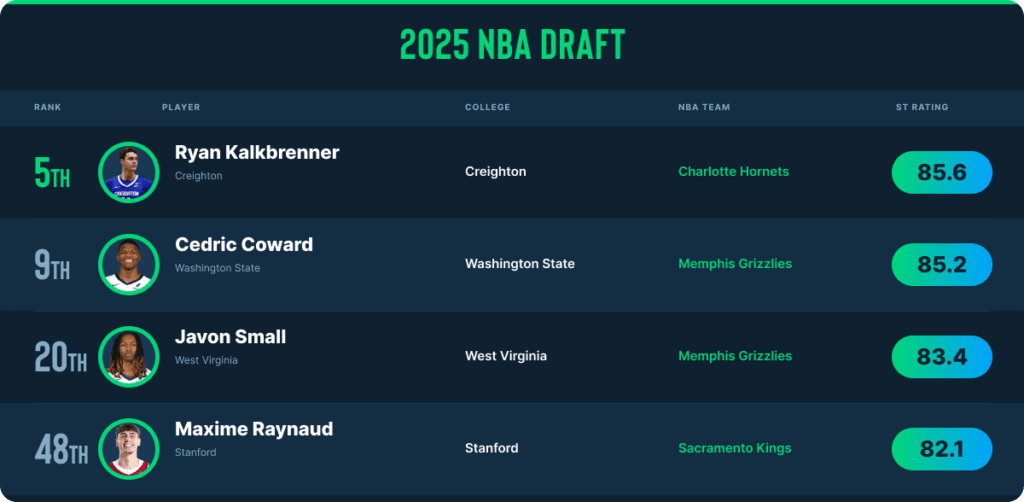
Ryan Kalkbrenner, Charlotte Hornets
ShotTracker Rating: 85.6 | ShotTracker Rank: 5th
Kalkbrenner carried the highest ShotTracker rating of the four at 85.6 and ranked fifth nationally. Four Big East Defensive Player of the Year awards and a Kareem Abdul-Jabbar Award did not stop scouts from raising questions about his lateral quickness and ability to guard at the next level. Charlotte answered those questions by taking him 34th overall and watching him shoot 80.8% from the field through his first ten games as a professional, one of the most efficient starts to an NBA career in recent history.
The data saw a winning big man. Charlotte found him at the beginning of the second round. The gap between perception and data does not get much wider than that.
Cedric Coward, Memphis Grizzlies
ShotTracker Rating: 85.2 | ShotTracker Rank: 9th
Coward walked into draft night carrying questions. He had lost nearly his entire college season to shoulder surgery and spent the offseason caught between a potential Duke transfer and the draft. None of that moved ShotTracker’s rating of 85.2. The platform had him ranked 9th in the country based on a profile that showed a wing who could create off the catch, defend multiple positions, and impact winning in ways that did not always appear on an opponent’s scouting report.
Memphis selected him 11th overall. He averaged 13.6 points, 5.9 rebounds, and 2.8 assists across 62 games and landed on the All-Rookie First Team. The debate about whether he was ready was settled before the season was halfway done.
Javon Small, Memphis Grizzlies
ShotTracker Rating: 83.4 | ShotTracker Rank: 20th
Small went 48th overall and signed a two-way contract, which put him in the category of players most observers expected to cycle in and out of the G League throughout the year. When the Grizzlies faced injuries and navigated a mid-season Jaren Jackson Jr. trade, Small stepped into a starting role and averaged 14.8 points, 5.2 assists, and 1.4 steals in just under 30 minutes per game. Memphis has a documented history of identifying second-round value. ShotTracker had him ranked 20th in the country. The Grizzlies found him exactly where the data suggested they would.
Maxime Raynaud, Sacramento Kings
ShotTracker Rating: 82.1 | ShotTracker Rank: 48th
Sacramento selected Raynaud 42nd overall out of Stanford, and what followed was one of the more quietly impressive rookie seasons in recent memory. He averaged 12.5 points and 7.5 rebounds on 57.1% shooting across 74 games, earned All-Rookie Second Team honors, and put up 18 double-doubles while stepping into the starting lineup during a stretch when Domantas Sabonis was unavailable. That production placed him in select company alongside Shaquille O’Neal, Chris Webber, and Deandre Ayton as the only rookies to average 12 and 7 while shooting above 55%.
ShotTracker’s rating of 82.1 had Raynaud as one of the most complete players in the country and the third-best player in the ACC behind Cooper Flagg and Kon Knueppel. Despite that, he still fell to the middle of the second round. Sacramento found a steal. The data had him circled for months before the pick was made.
Four players. Four data points. One full season of proof.
The 2026 Class: The Data Is Pointing Again
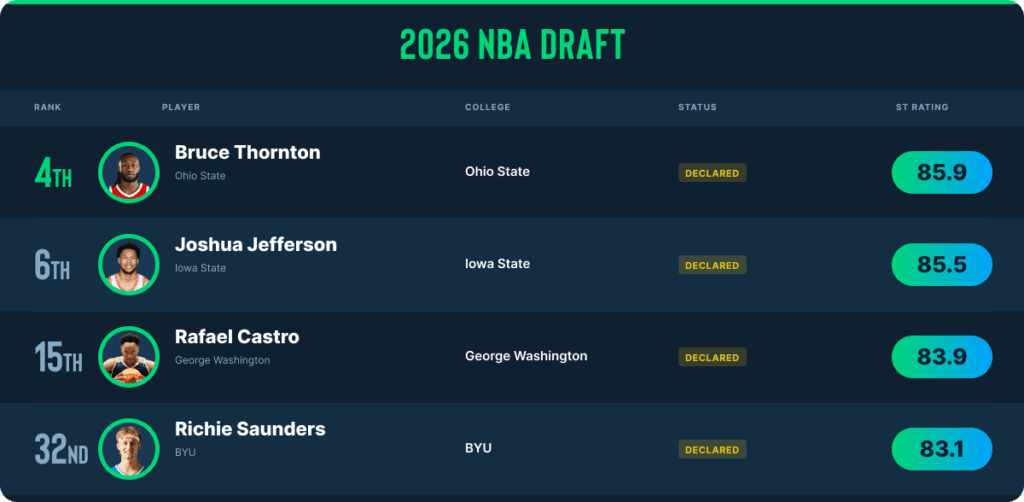
The 2026 NBA Draft takes place next week in Brooklyn. The debate between AJ Dybantsa and Darryn Peterson has rightfully dominated the conversation for months, but last year’s results are a reminder that the most compelling stories rarely live at the top of the board.
None of the following four players project as lottery picks. What makes them worth watching is the gap between where ShotTracker has them ranked based on their 2024-25 season data and where mock drafts currently project them to land. That gap told a story in 2025. It is telling one again now.
Bruce Thornton, Ohio State
ShotTracker Rank: 4th | Projected: Late 2nd Round
Thornton left Columbus as Ohio State’s all-time leading scorer and just the second player in Big Ten history to finish with 2,000 points, 500 rebounds, and 500 assists. His senior averages of 19.9 points, 5.1 rebounds, and 3.9 assists produced a ShotTracker rating of 85.91, fourth best in all of college basketball last season. Four years of elite efficiency, sharp decision-making, and consistent winning at a major program is a profile that tends to translate. Whoever finds him in the second round will feel good about that pick very quickly.
Joshua Jefferson, Iowa State
ShotTracker Rank: 6th | Projected: Late 1st to Early 2nd Round
Jefferson averaged 16.4 points, 7.4 rebounds, and 4.8 assists while shooting 47.1% from the field and became the first player in Big 12 history to record multiple triple-doubles in conference play in a single season. His ShotTracker rating of 85.53 from the 2025-26 season ranks him sixth nationally and projects him as the kind of player who impacts winning in multiple ways from day one at the professional level. His draft range puts him in late first or early second round territory, and that feels about right given what the data says about his ceiling.
Rafael Castro, George Washington
ShotTracker Rank: 15th | Projected: Late 2nd Round to Undrafted
The gap between ShotTracker’s evaluation and the consensus projection is widest here. Castro ranks 15th nationally in the 2025-26 ShotTracker ratings with a score of 83.94. ESPN’s latest mock draft has him going 54th overall, and several boards project him as an undrafted free agent. He averaged 15.3 points and 9.1 rebounds on 62.7% shooting in his senior season at George Washington and added 3.5 combined steals and blocks per game. The skepticism around his competition level in the Atlantic 10 is fair, but his performance at the G League Elite Camp earned him an NBA Combine invitation and he continued to impress there. If he is still available in the back half of the second round, the team that takes the chance will be pleased with what they get.
Richie Saunders, BYU
ShotTracker Rank: 32nd | Projected: Consensus 2nd Round
Saunders tore his ACL in the opening minute of his 26th game of the season against Colorado in February, which ended his college career and introduced significant uncertainty into his draft stock. Before the injury, he was averaging 18 points, 5.4 rebounds, 2.1 assists, and 1.7 steals per game while shooting 38.7% from three over the course of his career. His ShotTracker rating of 83.1 from the 2025-26 season reflects his off-ball movement, defensive activity, and overall shot-making. Recovery is reportedly ahead of schedule. The draft will determine where he lands, but the data already knows what kind of player he is.
Last June, the gap between ShotTracker’s ratings and where four players landed told a story that took a full season to unfold completely. Raynaud. Coward. Kalkbrenner. Small. All four entered the league with data that pointed toward real NBA impact. All four have delivered.
Next week, 60 new names will be announced in Brooklyn. The data is already pointing. It is up to the room to listen.
Want to Go Deeper?
The ShotTracker Rating is built to surface value that traditional scouting misses. And if you want to see how ShotTracker’s platform can give your program the same edge these front offices had last June, we would love to show you what it looks like in action. Request a demo.