Every year, a player’s college stat line becomes the most important document in his professional life. Every year, it quietly misleads the people reading it. NBA Summer League 2026 showed why.
A box score can tell you what a player did inside one specific system, in one specific role, surrounded by one specific group of teammates. It cannot tell you what that player is actually capable of when the system changes.
NBA Summer League 2026 is where that gap becomes visible for the first time. New roles, new teammates, new instructions. The player who shows up in Vegas is often a different-looking version of the one who just left campus, and that difference tells you more about what is coming than four years of college footage ever could. This year’s tournament gave us four contrasting top picks, four returning contributors proving last season was no accident, and one player who arrived in Vegas with a ShotTracker rating that told us exactly what to expect.
The Top Four Picks
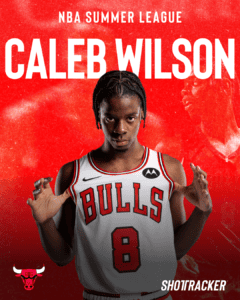
In 24 games at North Carolina, Caleb Wilson made seven three-pointers total. He shot 27 attempts all season and connected on 26% of them. His Vegas debut rewrote that story entirely. Wilson shot 7-of-11 from three, finished with 35 points on 12-of-21 shooting from the field, and broke the Las Vegas Summer League record for most points ever scored in a debut, all in the same game. By the end of the week he had hit 13-of-31 from three across four games, averaged 23.5 points, 7.3 rebounds and 2.5 blocks, and walked out with All-Summer League First Team honors. The threes and the turnovers, 5.3 per game to lead all qualified players, both came from the same place.
At UNC, Wilson finished shots that a sophisticated offense created for him. In Vegas, head coach Tiago Splitter handed him the ball and asked him to create his own. He did. When you ask a player to operate at a usage level he has never experienced before, you see both sides of what he can become. Wilson showed both.
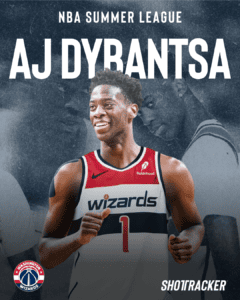
AJ Dybantsa, the No. 1 pick out of BYU going to Washington, is the most striking example of how a new role changes the numbers. He averaged 25.5 points per game at BYU on 51% shooting and arrived as the most anticipated prospect in the class. Across two Summer League games he shot 39.4% overall and went 1-of-11 from three. On the surface, that reads as a down performance.
Look at the full picture and the story is completely different. He scored 50 points in 50 minutes, the highest average any No. 1 pick has ever posted in Las Vegas. Eight of his nine rim attempts fell. He drew fouls at 10.08 per 36 minutes, a rate higher than any player sustained in the NBA all of last season. Dybantsa did not score the same way he scored in college. He found a more efficient way.
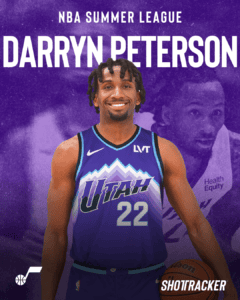
Darryn Peterson, the No. 2 pick out of Kansas to Utah, barely moved his scoring average. He averaged 23.0 points per game across the summer against 20.2 at Kansas. What changed was everything around it. Peterson averaged 1.6 assists per game across 24 college games. In Summer League, he averaged 5.2, headlined by a 25-point, 12-assist performance that led everyone on the floor in both categories. The player who shot his way through his freshman season showed up in Vegas as someone who can run an NBA offense. That is the information a college box score could not provide.
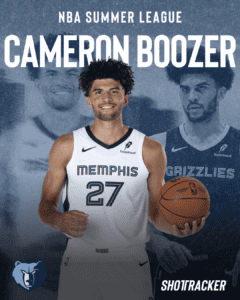
Cameron Boozer, the No. 3 pick out of Duke to Memphis, offered the counterpoint to the three picks above. Where Wilson, Dybantsa and Peterson each looked like a different player in Vegas, Boozer looked exactly like the one Duke sent to the draft. He averaged 18.5 points, 8.0 rebounds, 3.7 assists and 1.8 steals per game and took Memphis all the way to the championship game. No new role, no rebuilt production path. The same all-around game, translated straight across.
Four top picks. Four different-looking box scores. The same player underneath each one, just handed a different set of instructions.
The Names the Data Already Knew
Before NBA Summer League 2026 tipped off, we wrote about four players who entered the 2025 draft with ShotTracker ratings that made a strong case for each of them regardless of where they were projected to land. A year later, all four were back in Vegas, not because they needed to prove anything, but because rebuilding teams give young players extra reps before training camp.
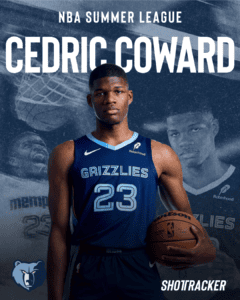
Cedric Coward was the clearest example. Memphis is building around him and Boozer, and NBA Summer League 2026 was his first appearance in Las Vegas after a shoulder injury wiped out his 2025 run. He played in all six games, averaging 19.0 points, 7.0 rebounds and 4.0 assists on 43.4% shooting and 41.7% from three. A player who just made All-Rookie First Team and still had ground to cover in Vegas. He used the time well.
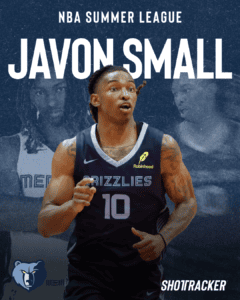
Javon Small was in Las Vegas for the reason two-way guards always are: to prove the backup point guard role should belong to him. He ran the Grizzlies’ Summer League offense at a near 5-to-1 assist-to-turnover ratio and got live minutes alongside the same rookies he will share a bench with in October. After a rookie season where he averaged 9.7 points and 3.7 assists but looked like a different player every time Memphis actually started him, Summer League gave him the chance to look consistent. He did.
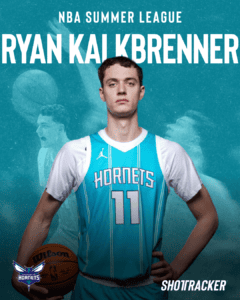
The Hornets saw enough from Ryan Kalkbrenner in three games. He averaged 3.7 blocks per night, the same rim protection that made him a rotation piece as a rookie while shooting 75.3% from the field last season. Three games was all Charlotte needed.
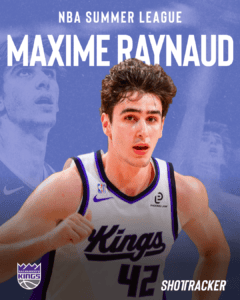
Maxime Raynaud got the least run of the four, resting most of the slate after arriving late from France’s World Cup qualifying window. His one full game against Washington produced 20 points, 12 rebounds and 3 assists, instantly recognizable as the rookie who made All-Rookie Second Team on 57% shooting. One game was enough to confirm he had nothing left to prove in Las Vegas.
The Bridge: Bruce Thornton
That same pre-draft piece flagged one more name, this time a year ahead. Bruce Thornton, ranked 4th nationally in ShotTracker rating at 85.91 during the 2025-26 college season. Mock drafts had him sliding to the late second round. Houston disagreed and traded up to take him at 31. NBA Summer League 2026 is where Thornton proved the data right and the mock drafts wrong.
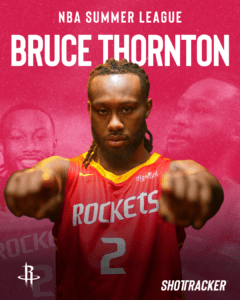
His debut against Denver produced 27 points on 7-of-18 shooting, a perfect 7-of-7 from the free throw line, 3 rebounds, 3 assists, 3 steals and a game-high plus-20, the most points by a Rockets rookie in a Summer League debut.
Ohio State’s all-time leading scorer. A four-time captain. One missed game across four years. A player whose value was never about whether any single shot went in, but about what he made happen on every possession around it. Thornton did not translate his game to a new level. He kept being the same player in a different building, which is precisely what a possession-level rating is built to identify and precisely what a draft board built on projection kept discounting.
What This Summer League Really Showed Us
NBA Summer League 2026 gave the basketball world two weeks to watch players in new roles and finally see who they are underneath the system they came from. Wilson and Dybantsa scored in ways their college numbers never suggested. Peterson showed off a playmaking dimension that a college box score buried completely. Boozer and the four returning contributors showed up looking exactly like themselves.
A stat sheet records what a player was asked to do inside a system. The player underneath is what actually carries from one level to the next.
Every April, NBA front offices are asked to make that same read without any of the Summer League footage. A transfer’s stat line describes an offense you do not run and a role you will not give him, and the gap between what he did there and what he will provide for your team is the entire decision.
ShotTracker exists to close that gap. Possession-level data on every field goal attempt. Every screen. Every action. The player underneath the stat line, visible before Vegas ever tips off. Interested in seeing how ShotTracker’s data surfaces the player underneath the numbers for your program? Request a demo at shottracker.com/request-a-demo.