The analytics debate has been loud lately. Most of it has been missing the point entirely. Here is what serious analytics actually does, and what it does not.
When an anonymous NBA analytics source ranked Jaylen Brown as the seventh-best player on the Boston Celtics, Brown responded directly. “Analytics nowadays used to discredit and control narratives. Roll the ball out, none of these guys better than me on both ends.” Days later, Brown was traded to Philadelphia for Paul George, two future first-round picks, and two future second-round picks.
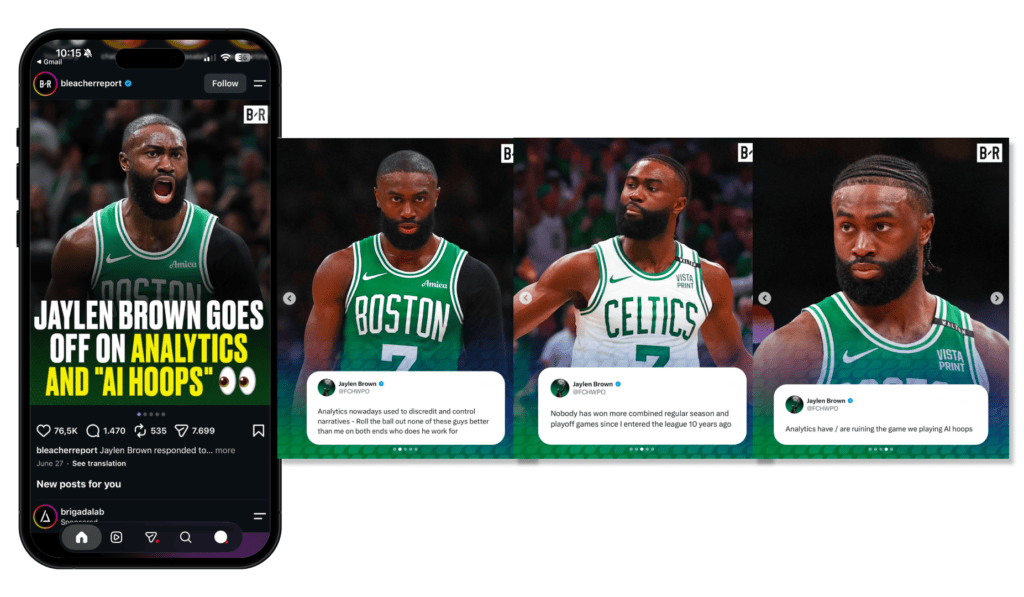
What happened in the aftermath had almost nothing to do with analytics. It had everything to do with how data gets stripped of context, delivered without accountability, and weaponized instead of used. Strip a number of its context and deliver it anonymously, and it stops being analysis. It becomes a verdict.
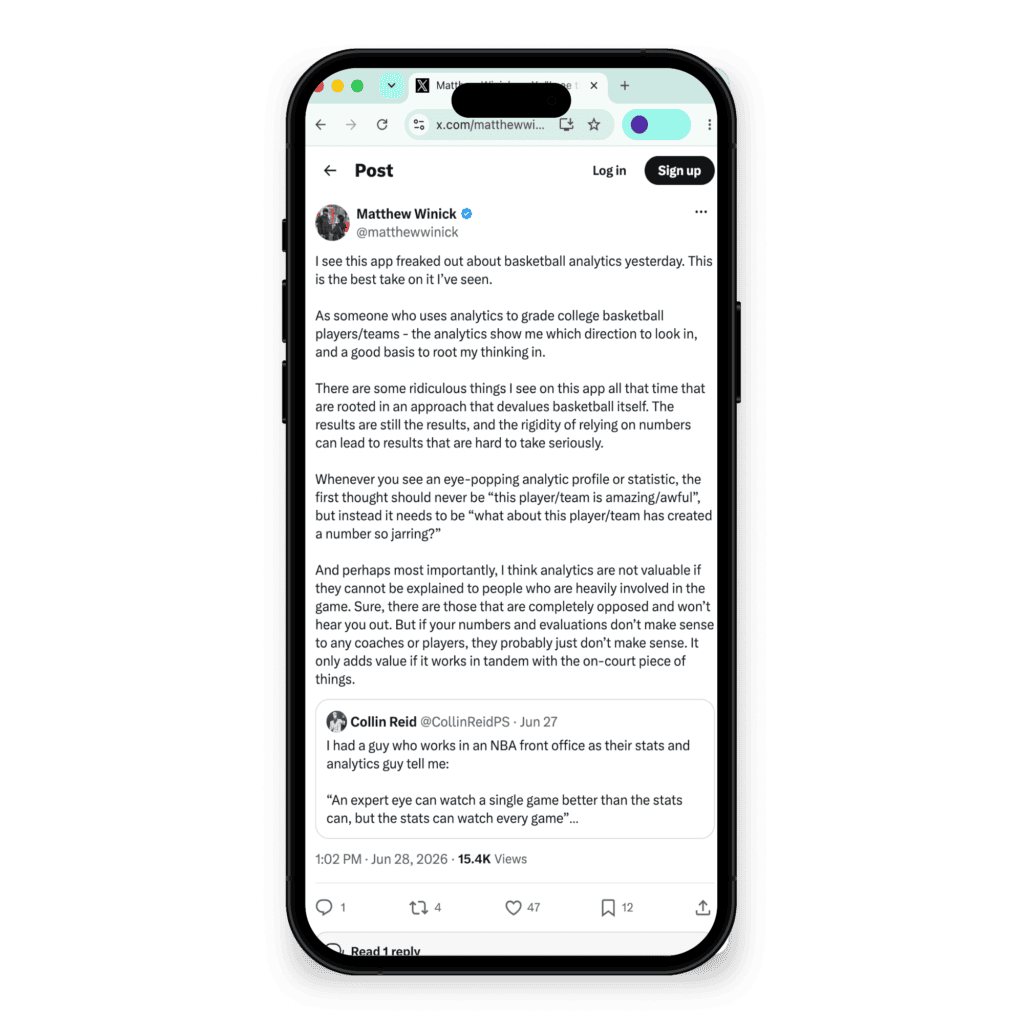
College basketball analyst Matthew Winick put it plainly: analytics show you which direction to look and give you a basis to root your thinking in. They only add value when they work alongside the on-court piece, not in place of it.
That is the version worth defending. Underneath all of the noise are three specific misconceptions that keep programs from accessing what data actually does well.
Myth 1: Analytics Means Shooting More Threes
This is the idea that players and coaches are most right to push back on. Take more threes. Eliminate the mid-range. Trust the math. It has become the default public understanding of basketball analytics, and it misses the question entirely.
The question was never where the shot came from. It was whether the decision to take it was a good one.
That is exactly what ShotIQ measures. Every shot captured receives a ShotIQ score built from four inputs: shot distance and location, shot type, defensive pressure, and game context. The result reflects the quality of the decision behind the attempt, completely independent of whether it goes in.
A pull-up mid-range off a ball screen with space and rhythm is a high ShotIQ shot. A contested three forced up at the end of the shot clock is not.
Serious analytics is not anti-mid-range. It is anti-bad decision. A player with a high ShotIQ but an average field goal percentage is making the right calls. The execution will catch up. A player making bad shots that happen to be falling is a warning sign. Variance always catches up faster.
Myth 2: Analytics Cannot Measure Effort or Work Ethic
The concern is legitimate. If your analytics only capture games, you miss everything that matters most. The early mornings, the extra reps, the work that never gets announced. That critique is valid if your analytics stop at the final buzzer.
ShotTracker’s do not.
Helix lives in the practice gym. It tracks every shot in every session, capturing not just what a player produces on game day, but the work that builds toward it. Statistical volume over the course of a season tells a story no game log can. Players get personalized dashboards to monitor their own development, track their shooting zones, and compete with teammates on metrics that actually reflect what they are putting in.
Coaches get a year-round picture of who is showing up, how often, and what they are doing when no one is watching. That is not a grading system. That is an accountability system built around the work itself, not just the outcomes.
Myth 3: Analytics Is About Evaluating Players, Not Developing Them
This is the deepest misconception, and it is driving most of the frustration on both sides of the debate. The conversation that erupted recently was entirely backward-looking: what is this player worth, how do we rank them, what does the number say about a decision that already happened. That narrow use of data is the version most likely to produce the kind of decontextualized claim that sets players off and undermines trust in the process entirely.
ShotTracker’s Coaching Stack is built to answer a different set of questions. Helix delivers performance analytics across a full season, benchmarking development and identifying where the work is paying off and where gaps still exist. Pulse gives coaches real-time possession video and data on the bench so adjustments can happen in the moment, not just at halftime. Scout brings video and data together in a single voice-activated tool, with any footage from any possession pulled in under 60 seconds from anywhere.
The anonymous claim that sparked this week’s debate was looking backward at outcomes. Every product in ShotTracker’s Coaching Stack is built around what comes next.
The Real Answer
The answer is not less data. It is better data, used for the right purpose. A stack built around preparation and development, not rankings and verdicts. Analytics does not replace a coach’s eye or a player’s feel for the game. At its best, it sharpens both.
The debate that has been dominating timelines is about how data gets misused. The more important conversation is about how it gets used well, in the gym, with context, in service of the people actually playing and coaching the game.
So here is the real question: Is your program using data to develop players, or just to evaluate them?
Programs like UCLA Women’s Basketball and Oklahoma State Men’s Basketball, and dozens of others across the country are already using ShotTracker’s Coaching Stack to build that kind of development-first culture. The data is not replacing what makes those programs great. It is sharpening it.
If you want to see what development-first analytics looks like in practice, we would love to show you. Request a demo at shottracker.com.