Part 1 of the ShotTracker Player Archetypes series
Points and rebounds tell you what happened but Archetypes tell you who the player is.
ShotTracker built a series of player archetypes using statistical modeling to identify players with similar tendencies and roles. Not to rank them from best to worst but to describe how they actually impact the game, using the 100+ data fields as the foundation.
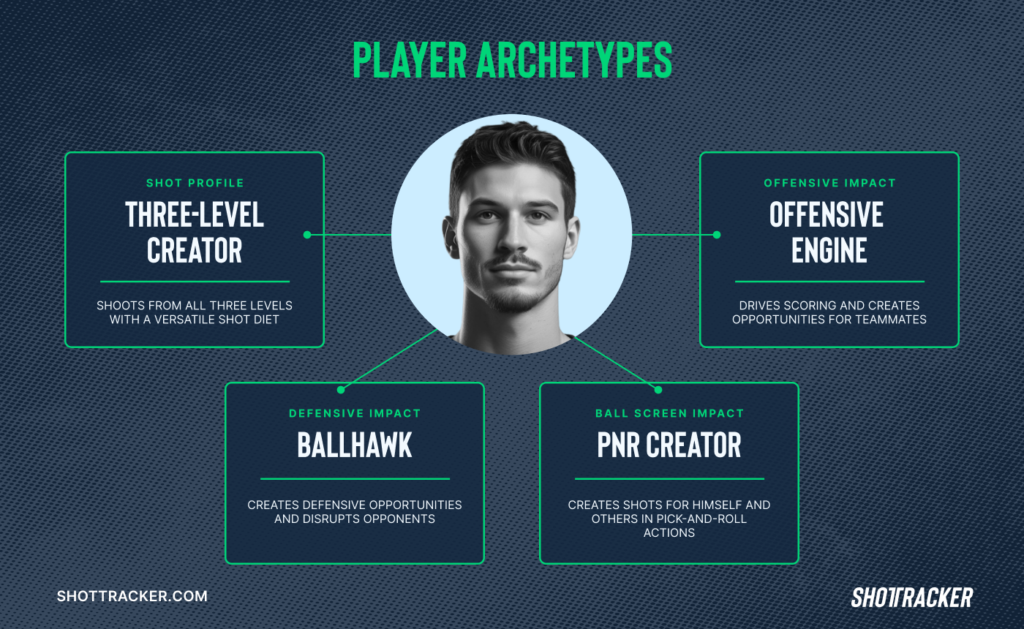
Each player is classified across four areas:
Shot Profile – Where and how a player takes their shots
Offensive Impact – How a player contributes to the overall offense
Defensive Impact – How a player affects the game on the other end
Ball Screen Impact – How a player operates as a ball handler or screener
Each category is modeled independently, so a player can be a “Three-Level Creator” by Shot Profile, an Offensive Engine by Offensive Impact, a Ballhawk defensively and a PnR Creator in ball screens. The combination is the player and the data now proves it.
This first installment focuses on Shot Profile – built entirely around how a player takes their shots. The model accounts for where players shoot on the floor, the types of shots they take (jumpshots, stepbacks, layups, dunks) and how those shots are generated: catch-and-shoot versus off the dribble. Together, those tendencies form a statistical picture of who a player is as a scorer.
Because the men’s and women’s datasets were modeled independently, the archetypes aren’t identical. Several playing styles appear in both games. Others are unique to one. Eight archetypes emerged in the men’s model. Seven in the women’s.
Here’s a look at four from each.
Men’s Shot Profile Archetypes
Each graph shows where the average player within an archetype ranks percentile-wise across each statistical category. “Paint” refers to the non-restricted paint area.
Three-Point Specialist
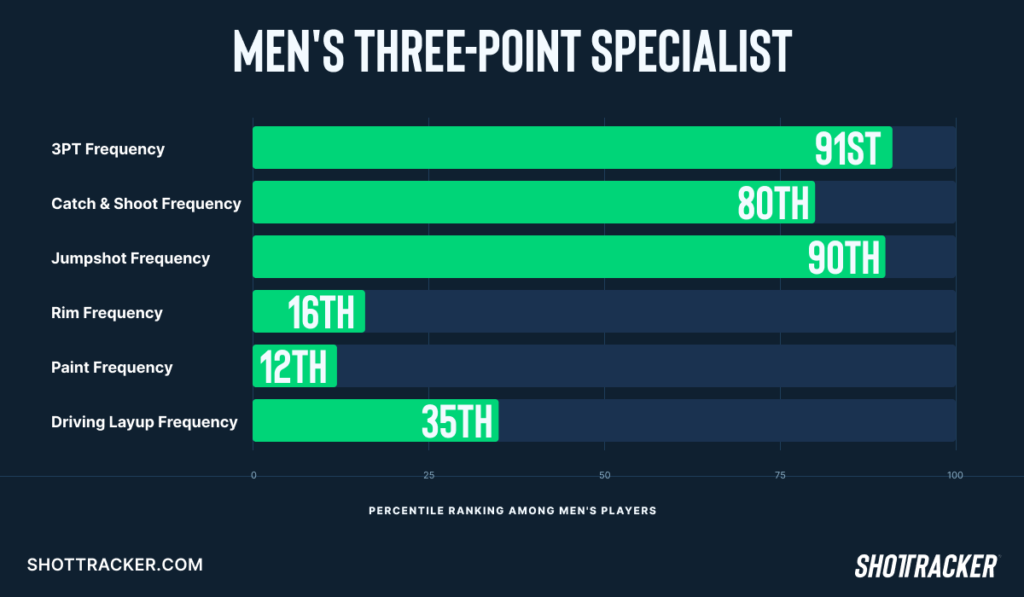
The Three-Point Specialist lives on the perimeter. Three-point attempts rank at the 91st percentile. Jumpshot frequency sits at the 90th. Rim attempts land at the 16th percentile. Paint frequency at the 12th. Their shot diet is built almost entirely on the arc, and they rely on teammates and offensive actions to create opportunities rather than attacking downhill. That makes them exactly what their name says: floor spacers who stretch the defense and punish teams that can’t guard the line.
Notable Three-Point Specialists from the 2025-2026 NCAA season: Pryce Sandfort (Nebraska), Jadin Booth (Samford), Tyler Lundblade (Belmont)
Three-Level Creator
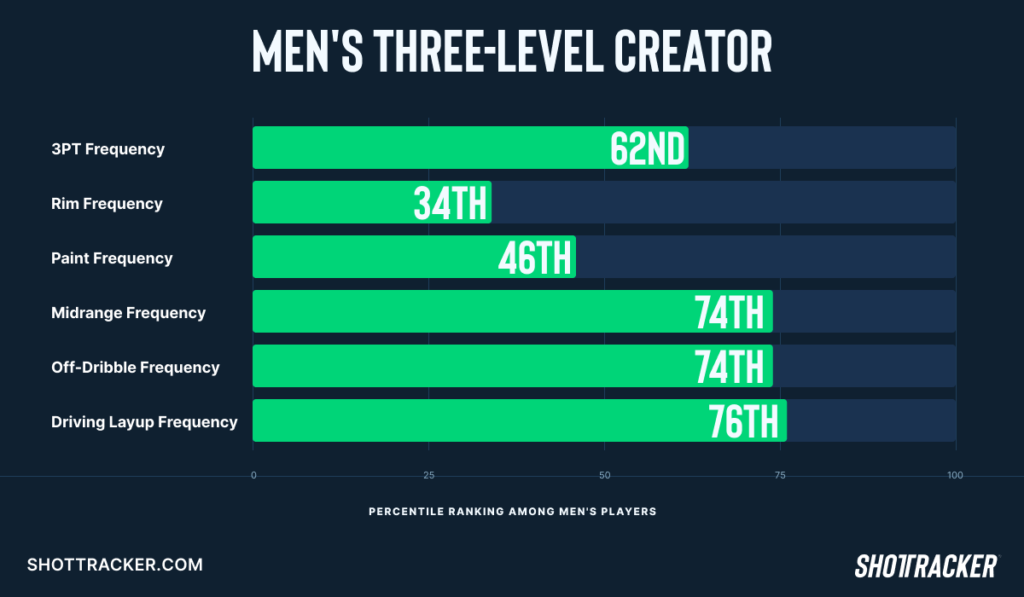
The Three-Level Creator doesn’t need to be told where to score. They figure it out. These players sit in the middle of the pack for three-point, rim, and paint frequency, but separate themselves in two specific areas: midrange attempts and off-the-dribble frequency (74th percentile in both). They aren’t reliant on one area of the floor. Their shot diet is diverse, their angles are unpredictable, and their ability to create at all three levels makes them one of the harder players to game-plan against.
Notable Three-Level Creators from the 2025-2026 NCAA season: Darryn Peterson (Kansas), Labaron Philon (Alabama), Ebuka Okorie (Stanford)
Interior Craftsman
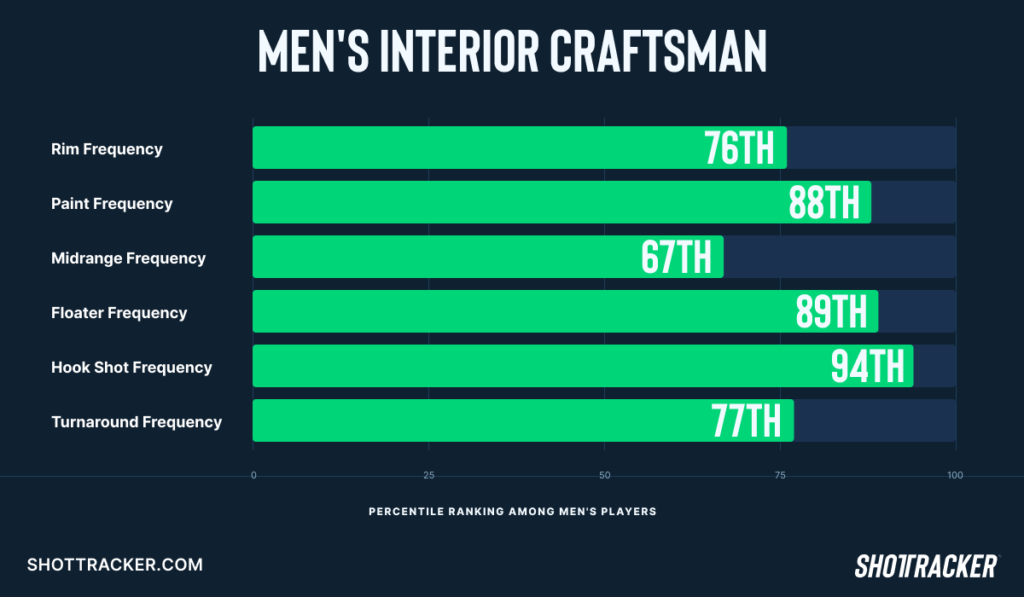
The Interior Craftsman scores inside, but it’s not just about getting to the rim. These players rank high in rim, paint, and midrange frequency — but what separates them is the toolkit. Hook shots at the 94th percentile. Floaters at the 89th. Turnarounds at the 77th. They can finish at the basket, but they don’t have to. Touch, footwork, and a range of interior finishes make them difficult to stop without putting them on the line.
Notable Interior Craftsmen from the 2025-2026 NCAA season: Paulius Murauskus (St. Mary’s), Braden Huff (Gonzaga), Nate Bittle (Oregon)
Lob Threat
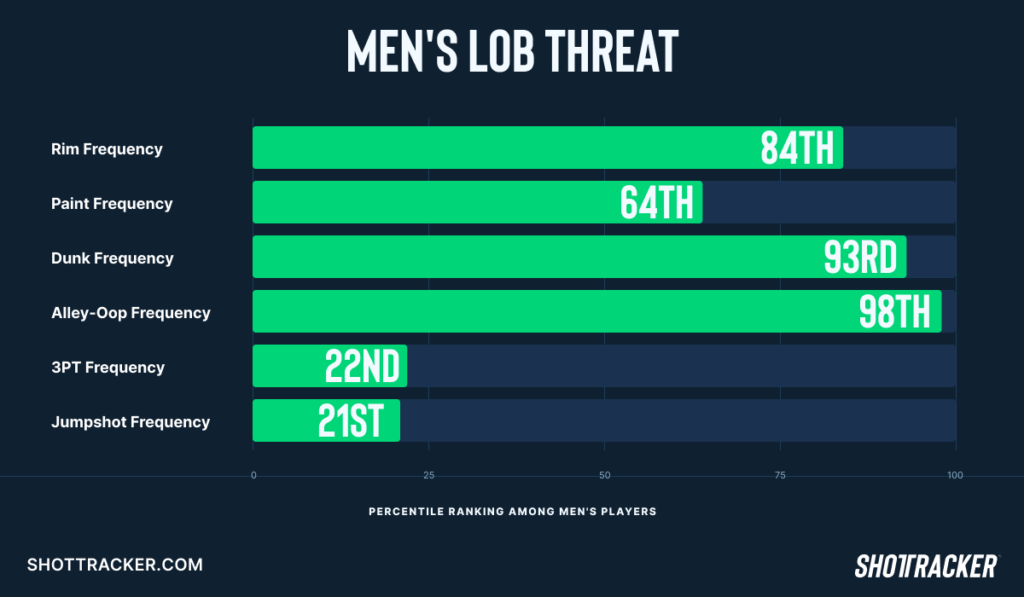
The Lob Threat finishes plays, not creates them. Alley-oop frequency sits at the 98th percentile. Dunk frequency at the 93rd. Catch-and-shoot frequency is high (76th percentile), which reflects how often these players are on the receiving end of an opportunity rather than generating their own. That doesn’t mean a Lob Threat can’t handle the ball or step outside. But their shot profile is built around one thing: get to the rim and convert when the opportunity comes.
Notable Lob Threats from the 2025-2026 NCAA season: Caleb Wilson (North Carolina), Rafael Castro (George Washington), Koa Peat (Arizona)
Women’s Shot Profile Archetypes
Slashing Creator
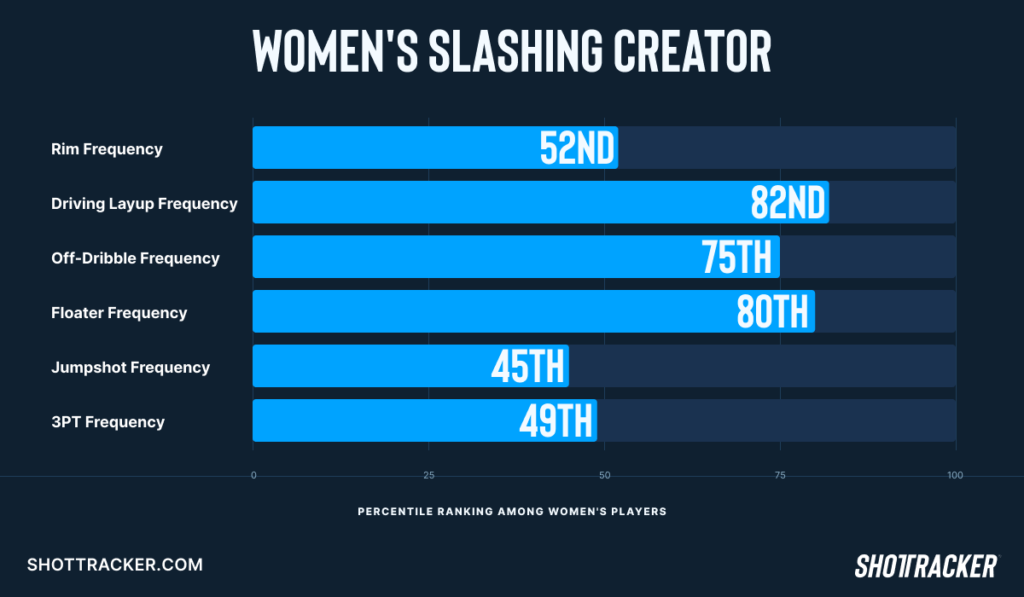
The Slashing Creator attacks the basket and creates off the dribble. Driving layup frequency, floater frequency, and off-the-dribble rate are the defining characteristics of this archetype. That doesn’t mean they’re one-dimensional — three-point and jumpshot frequency sit near the middle of the pack, giving them enough of a perimeter presence to keep defenses from loading up inside. But their identity is built around one thing: put the ball on the floor and get to the basket.
Notable Slashing Creators from the 2025-2026 NCAA season: Sarah Strong (UConn), Kiyomi McMiller (Penn State), Grace Slaughter (Missouri)
Dynamic Shot Creator
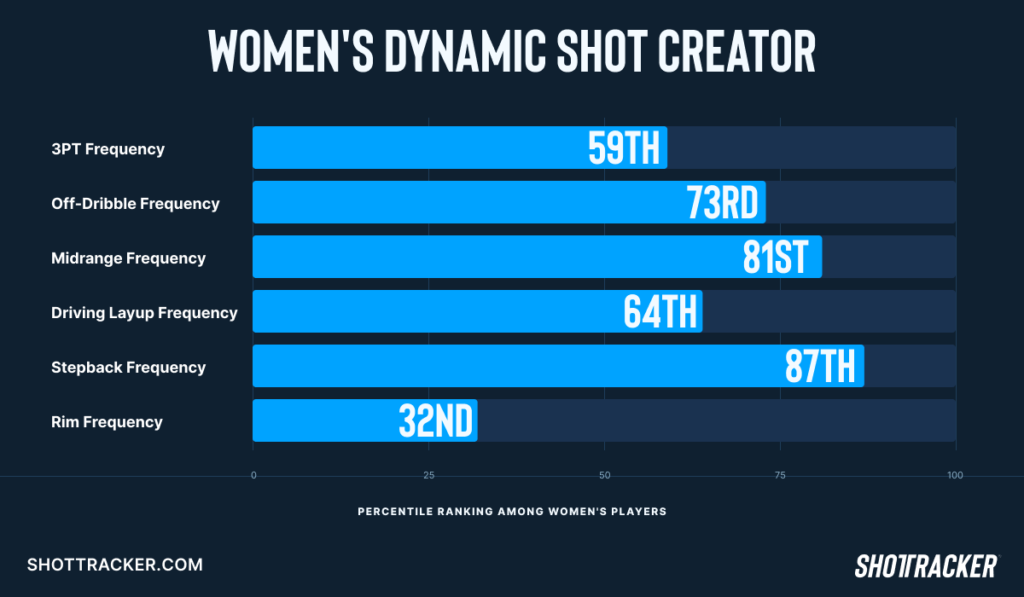
The Dynamic Shot Creator looks similar to the Slashing Creator on the surface. Look at the data and the distinction sharpens quickly. Midrange frequency at the 81st percentile. Stepbacks at the 87th. Fadeaways at the 84th. These players still get to the rim, but at a significantly lower rate than Slashing Creators (32nd percentile vs. 52nd). They favor off-the-dribble creation over catch-and-shoot, and their shot diet is more varied, their finishes more technical. They don’t need a straight line to the basket. They create shots from virtually anywhere.
Notable Dynamic Shot Creators from the 2025-2026 NCAA season: Mikayla Blakes (Vanderbilt), Hannah Hidalgo (Notre Dame), Liv McGill (Florida)
Inside-Out Threat
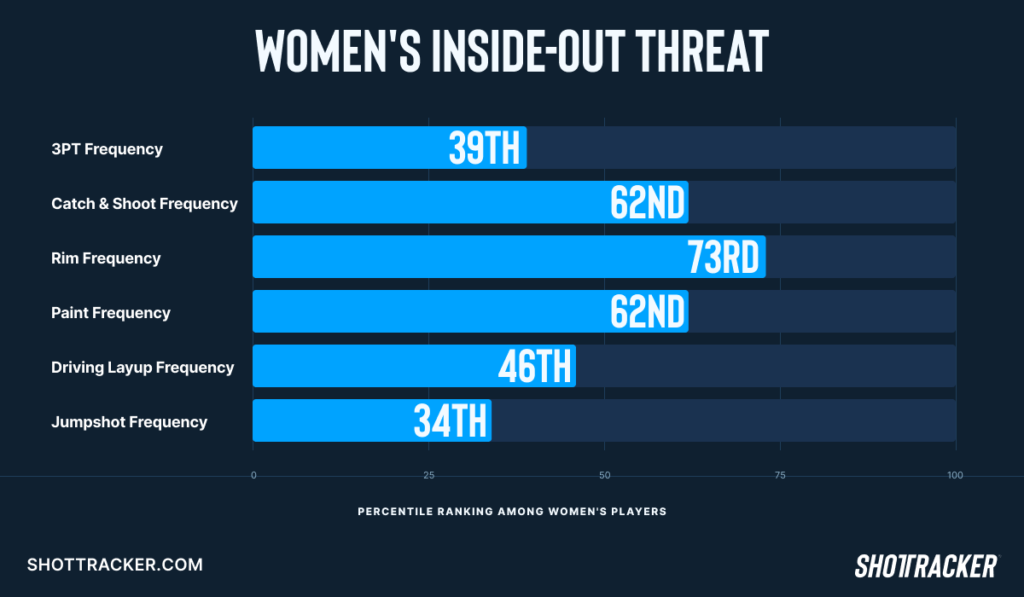
The Inside-Out Threat scores inside and can step out when the defense shifts. These players lean toward the paint and restricted area (62nd and 73rd percentile in paint and rim frequency), but they aren’t traditional post-only players. Three-point frequency sits near the middle of the pack (39th percentile). Catch-and-shoot attempts are above average (62nd percentile). That combination produces a shot profile that can shift between the interior and perimeter depending on what the defense allows — which makes them harder to scheme against than a player who only operates in one area.
Notable Inside-Out Threats from the 2025-2026 NCAA season: Mia Nicastro (Western Illinois), Joyce Edwards (South Carolina), Raegan Beers (Oklahoma)
Interior Force
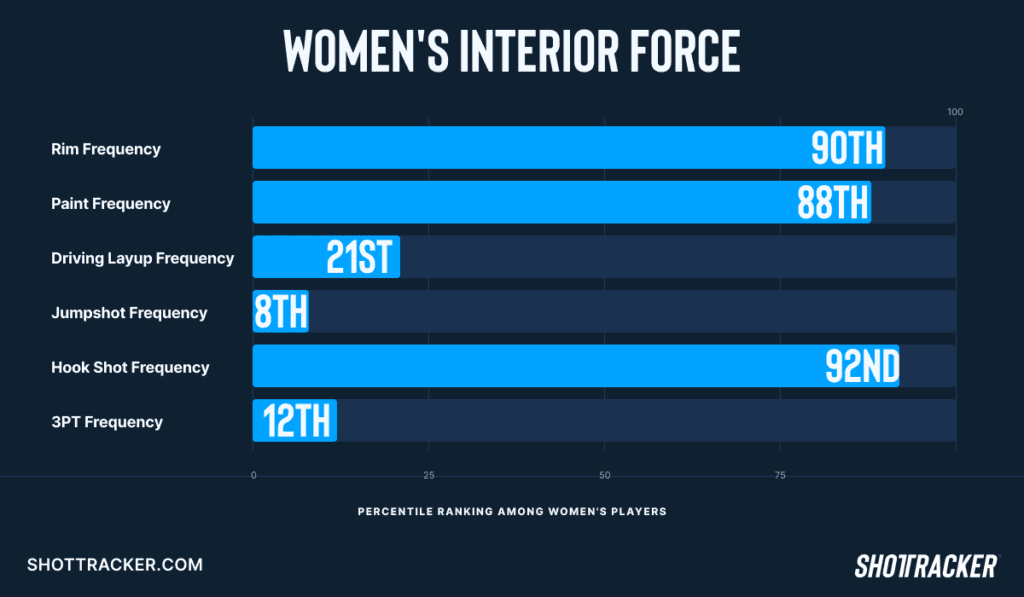
The Interior Force parks inside and scores. Nearly all attempts come from the paint or at the rim (88th and 90th percentile). Jumpshot frequency sits at just the 8th percentile. Three-point attempts at the 12th. Hook shots, though, are at the 92nd percentile. These players operate from established positions in the interior, using size, strength, and positioning to generate looks close to the basket — not creation off the dribble, not pull-up jumpers. Just space inside and the ball.
Notable Interior Forces from the 2025-2026 NCAA season: Audi Crooks (Iowa State), Lauren Betts (UCLA), Gracie Merkle (Penn State)
Shot Profile archetypes show that how a player gets their shots can be just as revealing as how many they make. From the Three-Point Specialist spacing the floor to the Interior Force dominating the paint, each archetype gives a clearer picture of what a player brings to the game.
But shot selection is only one piece of the puzzle.
Next in the series: Offensive Impact archetypes. The focus shifts from how players shoot to how they contribute to an offense as a whole. Stay tuned.