PART 1 OF SERIES | PACE OF PLAY
The jump from elite high school basketball to the NCAA is the most significant transition a player faces. New coaches, new systems, new defensive schemes, and a faster, stronger, more physical game on every possession. Most players know the competition gets better. What surprises them is how differently the game itself operates.
ShotTracker tracks data across multiple levels of the game, which creates a rare opportunity to compare how basketball actually changes as players move up. This series breaks down those differences starting with the one that catches most freshmen off guard – Pace of play.
The College Game Slows Down
College players are bigger, stronger, and faster than their high school counterparts, so the assumption is that the game moves faster. The data says otherwise.
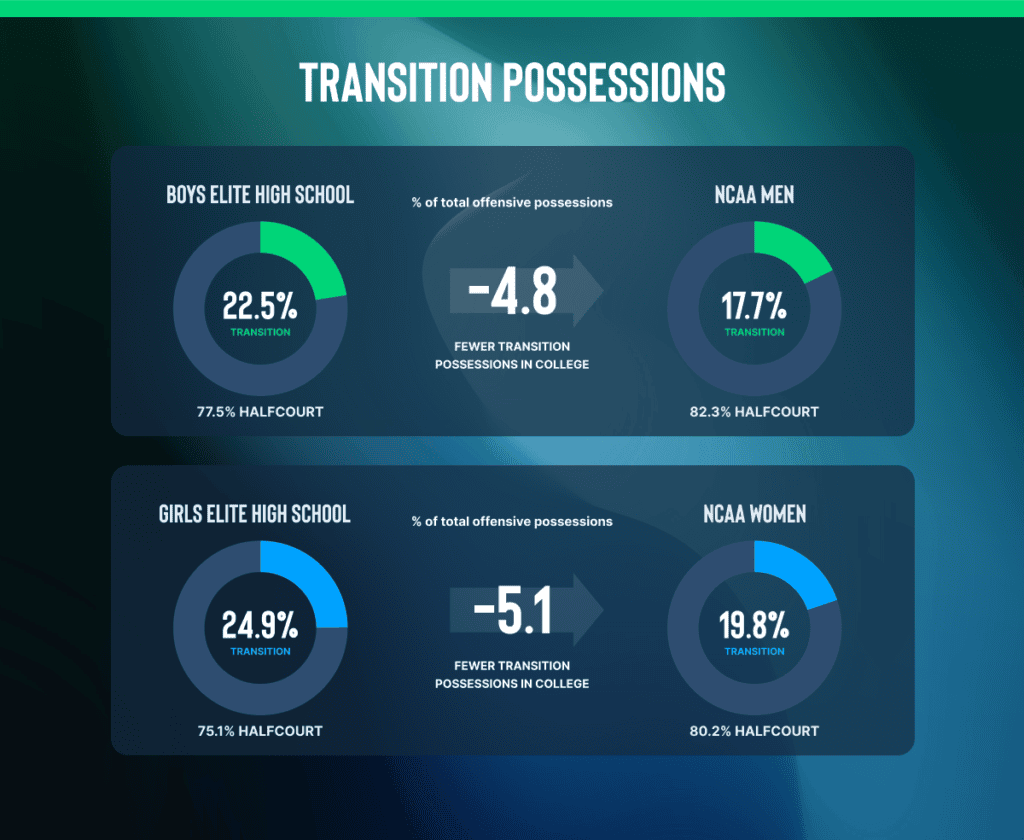
In the elite high school boys circuit, transition possessions account for 22.5% of all possessions. At the NCAA men’s level, that number drops to 17.7%. That means fewer than one in five college possessions comes in transition, compared to nearly one in four at the high school level. The pattern holds on the women’s side as well. High school girls average 24.9% of possessions in transition, while NCAA women’s programs average 19.8%.
Better athletes. Less transition. The college game is not faster. It is more deliberate.
College Teams Make the Clock Work for Them
NCAA teams do not just run fewer transition possessions. When they operate in the half court, they take significantly more time before attacking.
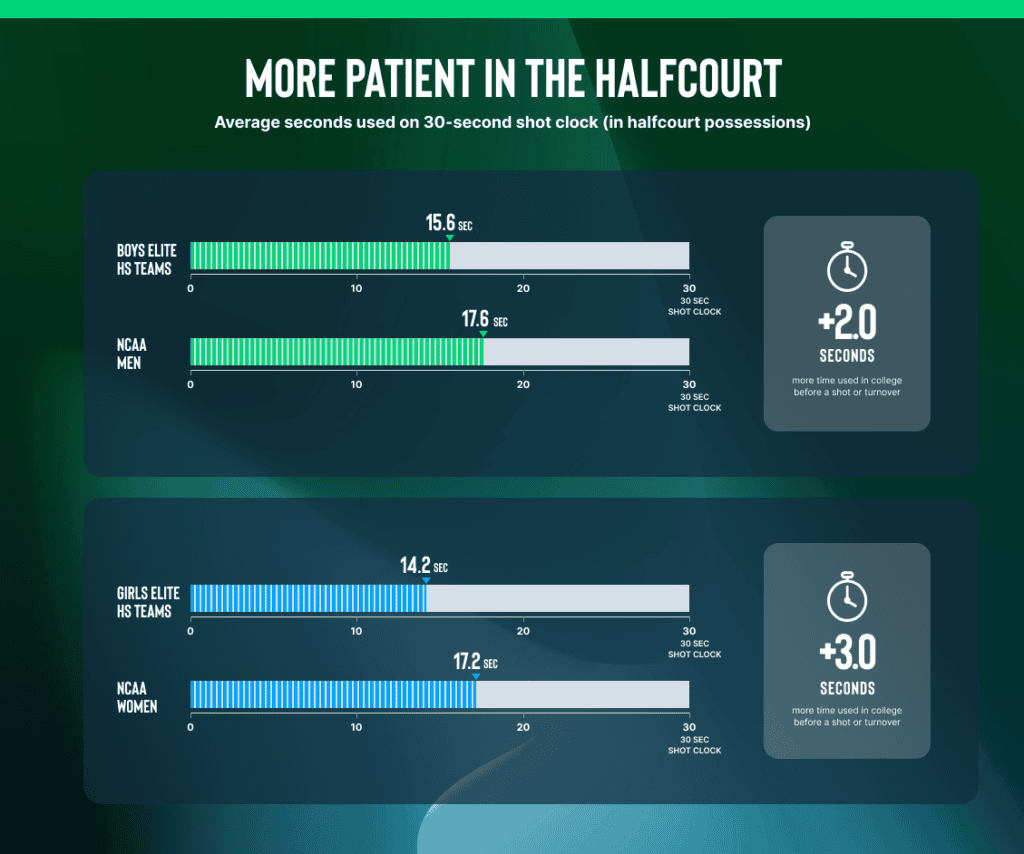
NCAA men’s teams use an average of 17.6 seconds of the 30-second shot clock on half-court possessions. High school boys use just 15.6 seconds on the same clock. Two seconds does not sound like much until you consider what fits inside those two seconds at this level: an extra pass, a second read off the defense, a better look created out of patience rather than urgency. On the women’s side, the gap widens further. NCAA women’s teams average 17.2 seconds of shot clock usage in the half court, compared to 14.2 seconds in high school, a three-second difference that reflects an entirely different offensive philosophy.
Why the Pace Difference Matters
College teams are not playing slowly for the sake of it. The extra time on the shot clock reflects a more layered offensive process: running multiple actions, reading defensive rotations, creating matchup advantages before committing to an attack. Every possession is treated as an opportunity to find the highest quality shot rather than the first available one.
For incoming freshmen, this is often the hardest adjustment to make. High school rewards players who are faster and more athletic than their opponents. College rewards players who can operate within a system, read the floor, and trust the process of building a possession rather than forcing it.
The physical leap gets all the attention. The mental and tactical adjustment is just as real.
Next in the series: How Shot Selection Changes from Elite High School Basketball to the NCAA.
Sources
High school boys data from the 2024-25 EYBL Scholastic League.
High school girls data from the 2025 EYBL Summer League.