31 wins. A Big South title. An NCAA Tournament upset. Now a completely new roster. Flynn Clayman’s program is not backing down from its standard.
This breakdown is powered by ShotTracker Scout. All player analysis and roster fit data referenced here is drawn from Scout’s AI-driven scouting platform.
Last season, High Point was one of the best stories in college basketball. A 31-5 record. A Big South championship. An NCAA Tournament win over Wisconsin. A program that proved small-conference basketball, done right, can compete on any stage.
This offseason, nearly everything changed. And that is not a warning. That is the point.
What They Had, and What Is Gone
High Point’s 2025-26 identity was built on a specific formula: interior dominance, elite transition offense, and one of the most efficient shooting profiles in the country. The Panthers posted a 1.006 overall PPP, a 1.213 PPP in transition, and finished at the rim at 64.1%. That system worked because of four players who are no longer on the roster.
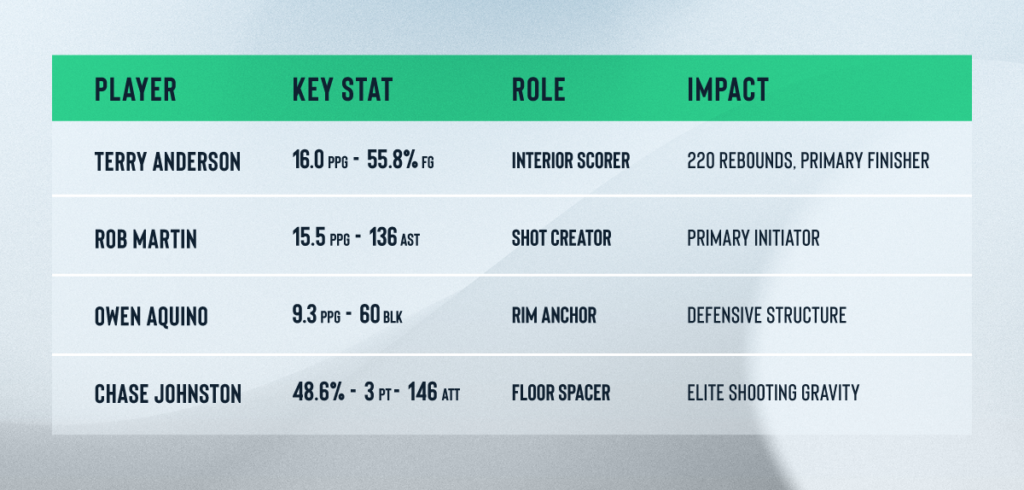
That is roughly 1,800 points of production gone, along with the structure around them. Interior scoring, shot creation, floor spacing, rim protection. All of it needs to be replaced, and not by finding four players who do the same things. By building something new.
The New Identity: Pace, Pressure, Versatility
The incoming group does not try to replicate what High Point had. It redefines what High Point can be.
Jason Rivera-Torres arrives from Monmouth via Vanderbilt with 15.8 points, 274 rebounds, 102 assists, and 70 steals per season. He is the two-way engine this roster is built around. His ability to push pace off turnovers and create in multiple ways makes him the new focal point of the offense.
CJ Brown (South Florida, 157 AST) steps in as the distributor that Rob Martin was, but in a more guard-driven, perimeter-first system. Frankquon Sherman and Isaac Garrett rebuild the frontcourt with rebounding and interior efficiency rather than shot-blocking. Liam Campbell (52% from three) quietly becomes one of the most important additions on the roster, giving High Point a reliable spacing option after losing Johnston’s shooting gravity.
This is not one player replacing another. This is a complete stylistic shift, from structured inside-out basketball to pace, pressure, and shared creation.
Returning seventh-year forward Cam’ron Fletcher anchors the continuity. His 54.8% field goal percentage and veteran presence give Flynn Clayman a trusted option as the roster finds its footing.
Why This Version of High Point Could Be Harder to Guard
Last season’s Panthers were predictable in the best possible way. You knew the paint was coming. You knew Johnston was spotting up in the corner. You could scheme for it, even if you could not stop it.
This version is less predictable. Multiple ball handlers, shared creation, active perimeter defenders generating turnovers and running. Rivera-Torres and Brown give High Point the kind of guard depth that can push pace in ways last year’s roster could not. The transition game, already elite at 1.213 PPP, gets faster and more chaotic.
Scout’s analysis projects High Point’s offensive style shifting toward higher guard-initiation and increased transition volume. The combination of Rivera-Torres’ steals and Brown’s assist rate creates one of the more disruptive defensive-to-offensive pipelines in the Big South.
The questions are real. Rim protection is thinner without Aquino. Shooting by committee is never a perfect substitute for one elite spacer. But those are questions every team in the Big South will have too.
High Point still has the coaching, the data infrastructure, and the culture that made last year work. That does not disappear when rosters turn over. It is the foundation everything else is built on.
The Bottom Line
This is not a step back. It is a pivot. High Point is trading structure for versatility, and predictability for pace. The ceiling has not moved. The path to get there just looks different.
For a program that already proved it belongs in March, that kind of adaptability might be the most dangerous thing of all.
See how Scout breaks down roster fits for your program at shottracker.com