Two Big 12 freshmen. One pick. ShotTracker tracked both players all season long, and the data makes a compelling case for each of them.
The 2026 NBA Draft has produced one of the most genuinely debated #1 pick conversations in recent memory. AJ Dybantsa and Darryn Peterson both played their freshman seasons in the Big 12, one of the most competitive conferences in college basketball, and both emerged as legitimate cases for the first selection in Brooklyn on June 23rd.
Their profiles could not be more different.
Dybantsa is a self-creating scorer who puts defenders in positions they cannot win. Peterson is an efficient, two-way guard with a shooting profile that translates immediately to the next level. The Wizards hold the pick. Here is what the data built over a full season of tracking says about both players.
AJ Dybantsa, BYU
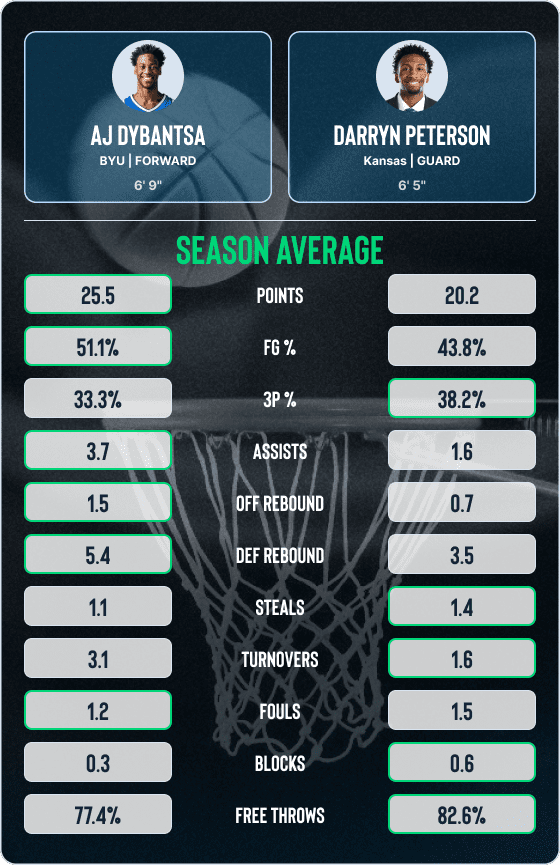
Dybantsa averaged 25.5 points per game on 51.1% shooting while generating 17.2 field goal attempts per game in the Big 12. Maintaining that kind of efficiency at that volume as a freshman in a power conference is something very few prospects in recent draft history have managed. The number alone is remarkable. The way he gets there is what makes him a generational conversation.
The Self-Creation Argument
What separates Dybantsa from nearly every other prospect in this draft is where his production comes from. He converted 53.2% of his off-the-dribble shots, which means defenders cannot simply take away the pass or wait for a handoff. The creation is his. He does not need a system to generate good looks. He is the system.
The full range of his shot menu is what makes him so difficult to scheme against. Driving layups converted at 58.1% on 155 attempts. Jump shots at 42.7% on 286 attempts. Step-back jumpers at 35.9%. Floaters at 44.4%. Turnaround jumpers at 50% on 18 attempts. Each one of those represents a different defensive problem, and Dybantsa can access all of them in the same possession.
Getting to the Line
Dybantsa shot 311 free throws on 635 total field goal attempts, producing a free-throw rate of 0.49 and averaging 8.4 attempts per game. That number is not a coincidence. It reflects a player who attacks the paint with purpose, draws contact consistently, and understands that getting to the line is as valuable as making the shot.
He is too big to guard on the perimeter, too skilled to contain at the rim, and aggressive enough to seek contact every time he attacks. The best players in the NBA have always found a way to manufacture free throws at an elite rate. Dybantsa is next in that line.
Darryn Peterson, Kansas
Peterson averaged over 20 points per game during his freshman season at Kansas while connecting on 38.2% of his 6.9 three-point attempts per game. In a draft environment that treats floor spacing as a premium attribute, that combination of volume and efficiency at the three-point line translates immediately. The shots Peterson takes are not catch-and-shoot gifts either. He creates separation off movement, and punishes defenders who lose him for even a moment.
The Shooting Profile
His effective field goal percentage of 52.7% reflects a shot diet built around high-value attempts. Peterson took 165 three-pointers and 191 two-point attempts across 24 games, a deliberate distribution that reflects real shot quality awareness rather than volume-first scoring. He is not hunting mid-range jumpers. Every shot in his game has a clear purpose.
Ball security reinforces the picture. Peterson averaged just 1.6 turnovers per game, which for a player handling his offensive responsibility is an indicator of decision-making maturity that many prospects never develop in college.
The Defensive Case
Where Peterson fully separates himself from the conversation around pure scorers is on the defensive end. His 1.4 steals and 0.6 blocks per game from the combo guard position point to elite length, timing, and anticipation. Those are not stats that come from effort alone. They reflect physical tools and defensive instincts that coaches cannot teach.
In a league that increasingly values wings who can guard multiple positions and disrupt without fouling, Peterson’s profile checks every box a front office looks for when they talk about two-way players at the guard spot.
One Pick
What the data makes clear after a full season of tracking both players is that this is not a debate between a good prospect and a great one. These are two elite but fundamentally different profiles making two entirely different arguments for the same pick.
Dybantsa’s case: scoring volume, self-creation, shot versatility, elite free throw rate, and the ability to put defenders in impossible situations on every possession.
Peterson’s case: perimeter shooting at scale, efficient shot selection, ball security, and defensive tools that project as a two-way contributor from day one.
Both players have a clear path to impacting winning immediately at the next level. The question the Wizards have to answer is which profile fits the direction they are building toward.
ShotTracker tracked both players throughout the entire season. The data built the argument for each of them. Now it is up to the front office to make the call.
Draft night is June 23rd in Brooklyn. The basketball world will be watching!