Note: Throughout this post, ‘bigs’ includes both forwards and centers. ‘OTD’ refers to off-the-dribble attempts, ‘CAS’ refers to catch-and-shoot attempts, and ‘FGA’ refers to field goal attempts. *All data sourced from ShotTracker. Analysis covers Division I men’s and women’s basketball
ShotTracker tracked every field goal attempt across Division I men’s and women’s basketball and broke down how often guards and bigs are creating their own shots versus shooting on the catch. The patterns are consistent between the men’s and women’s games, but differences arise between position groups, especially when digging into specific shot locations.
How Often Are Guards and Bigs Creating Shots?
Guards take 57.3% of their field goal attempts off the dribble and 42.7% catch-and-shoot. Bigs are essentially the opposite: exact 42.7% off the dribble and 57.3% catch-and-shoot. It reflects the reality of how most offenses are designed where guards initiate outside of the paint while bigs catch closer to the hoop and finish.
The women’s game follows the same pattern, though the overall OTD frequency is slightly lower for both groups. Women’s guards take 56.0% FGA off the dribble, and women’s bigs take 44.7%.
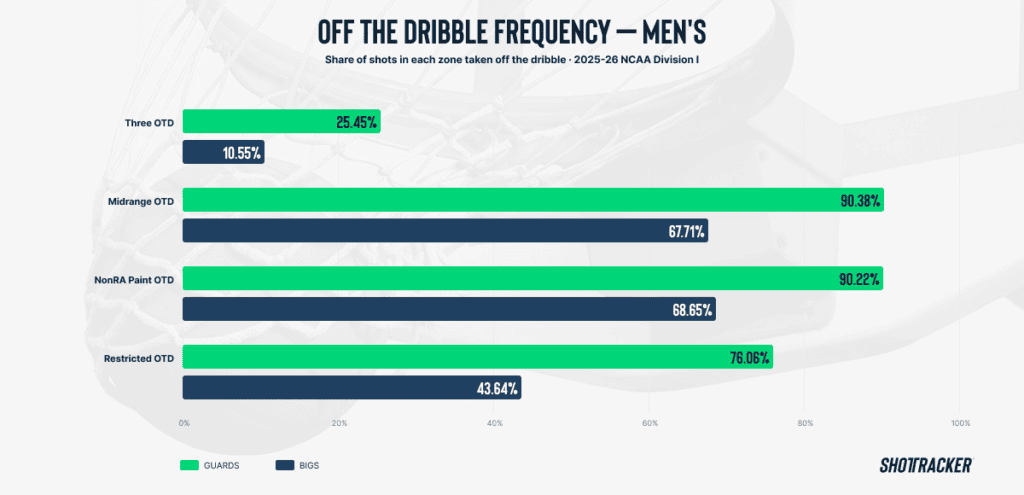
Breaking the numbers down by zone makes the difference even more apparent. In the restricted area, men’s bigs take fewer than half of their attempts off the dribble (43.6%), while guards take more than three-quarters of theirs that way (76.1%). The gap narrows slightly in the paint but remains significant: bigs are attempting 67.8% of their midrange OTD while guards are taking a much greater 90.4%.
Three-point creation seems to be heavily role dependent, with guards generating about a quarter of their three-point attempts off the dribble (25.5%) while bigs rarely do so at all (10.6%). That number reinforces something that tends to be true across most offenses: perimeter self-creation is primarily a guard function, and bigs are getting the vast majority of their three-point attempts through catch-and-shoot opportunities.
The Women’s Game by Zone
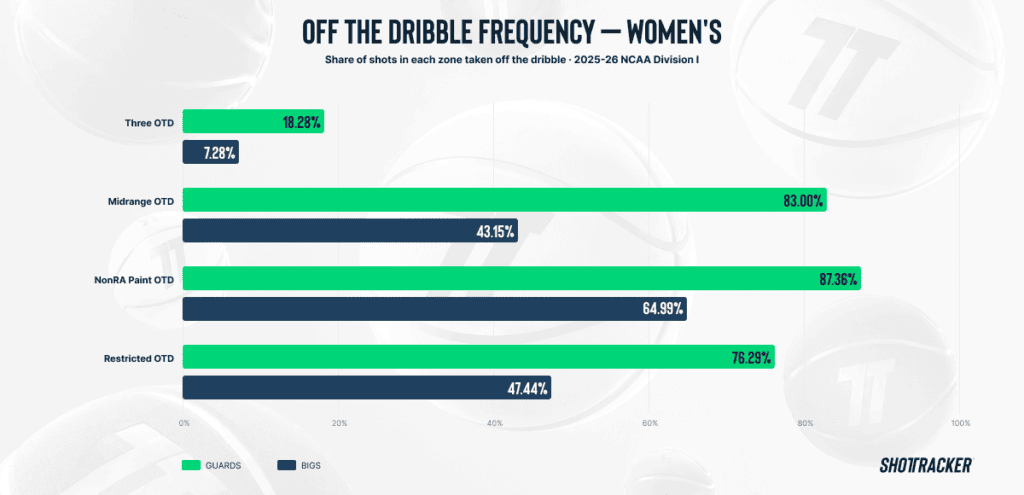
On the women’s side, the same trends appear. Women’s guards are at 56.0% OTD in the restricted area and bigs at 44.7%. The most notable difference shows up in the midrange, where the gap between groups is wider than in the men’s game. Women’s bigs take only 43.2% of their midrange attempts off the dribble, compared to 67.8% for men’s bigs, while women’s guards take 83.0% of their midrange attempts OTD.
Three-point creation follows a similar pattern to the men’s data, with women’s guards generating about 18.3% of their three-point attempts off the dribble versus 7.3% for women’s bigs.
Does It Matter? OTD vs Catch-and-Shoot Efficiency
Across every group and every zone, catch-and-shoot attempts convert at a higher rate than off-the-dribble attempts. The biggest gains come around the rim and in the paint (roughly 13 – 15 percentage points), while the smallest gap is in the midrange, especially for guards.
MEN
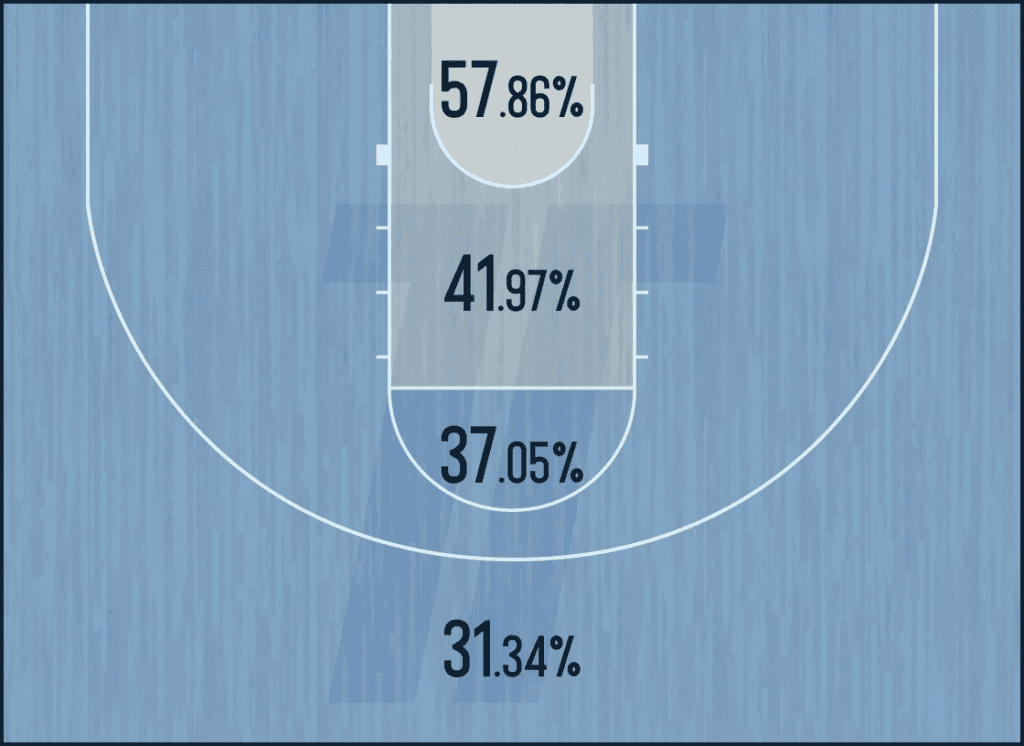
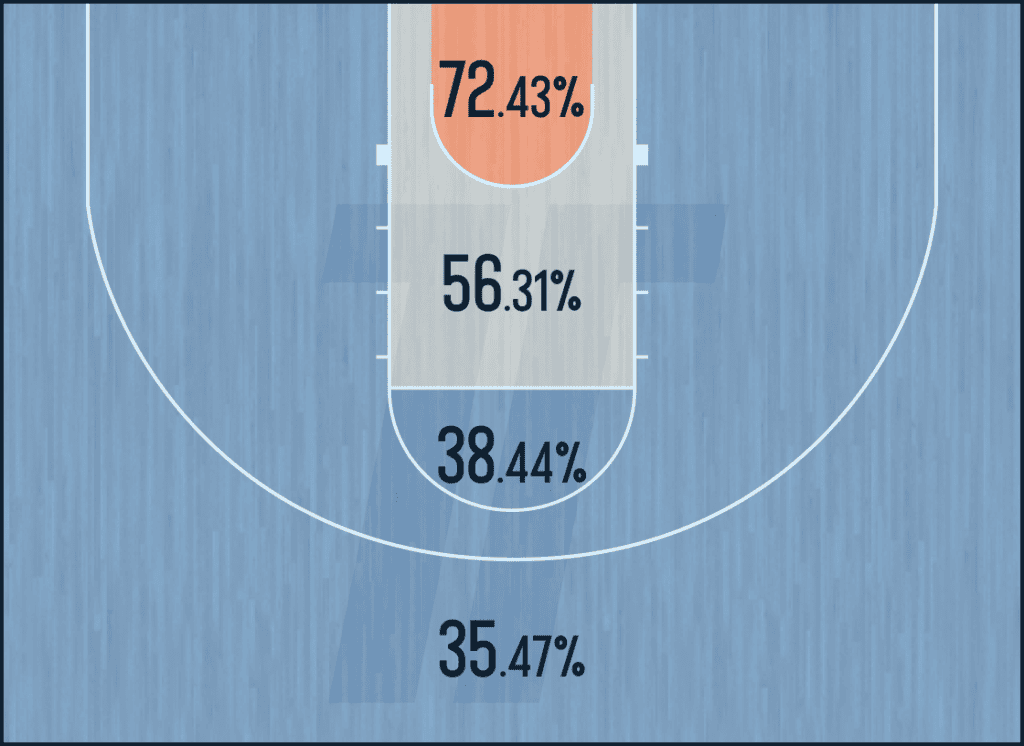
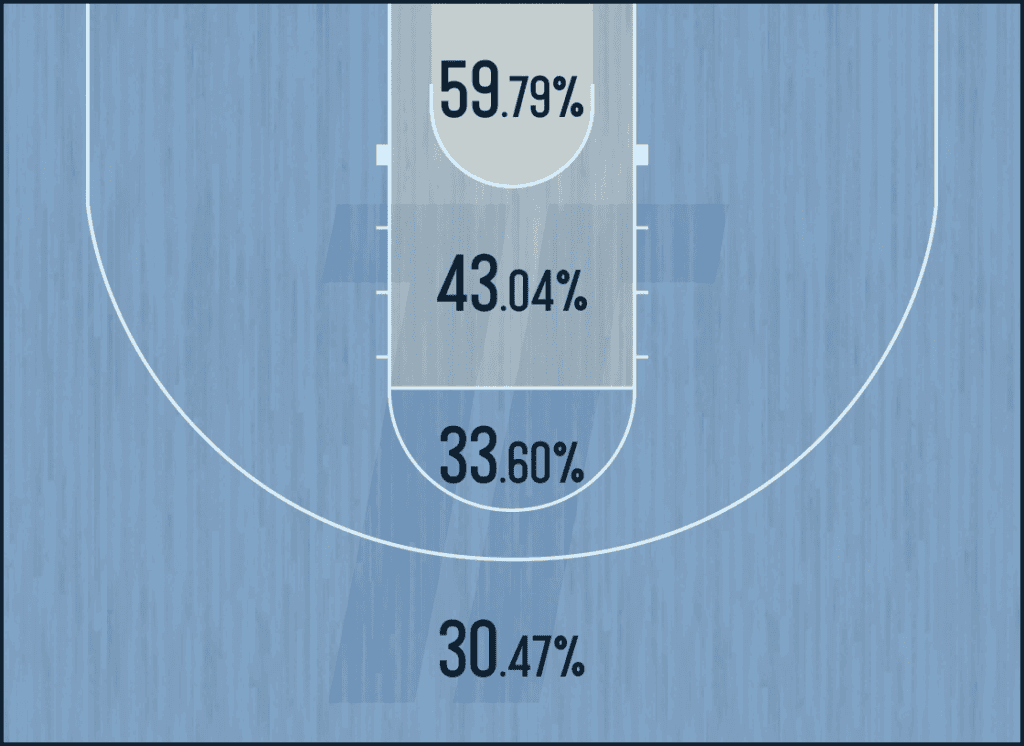
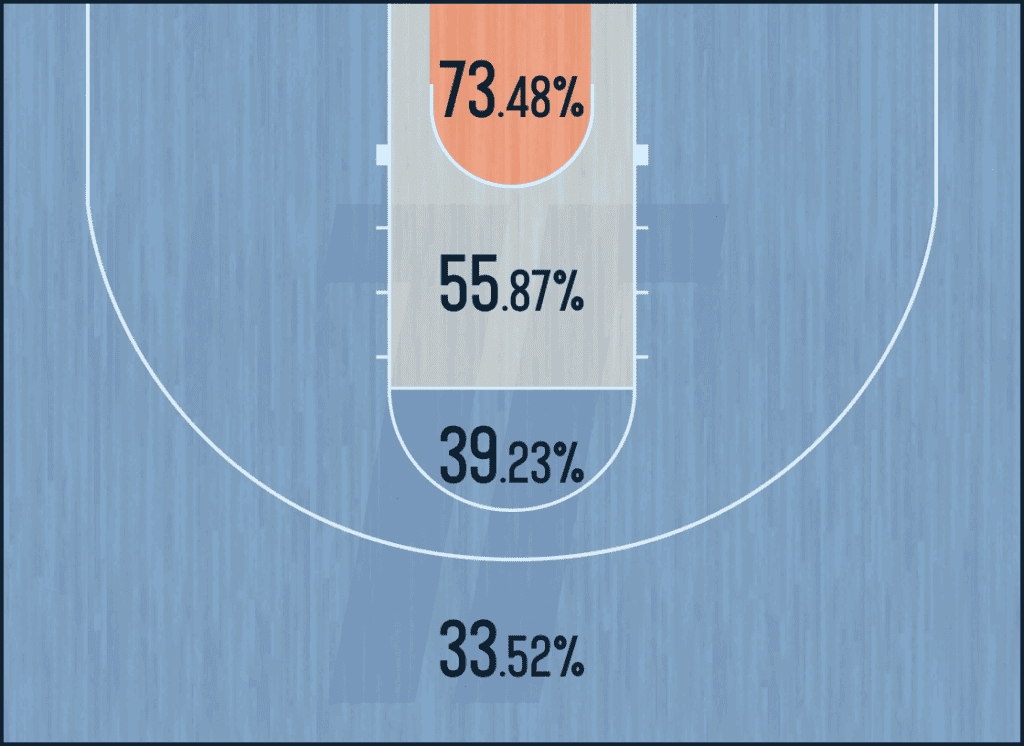
Guards and bigs also show an impressive improvement in three-point shooting, improving by over 3 and 4 percentage points, respectively, on the men’s side. There’s an even greater disparity in the women’s game, with bigs improving 5.6 percentage points from three, and guards improving 5 percentage points.
WOMEN
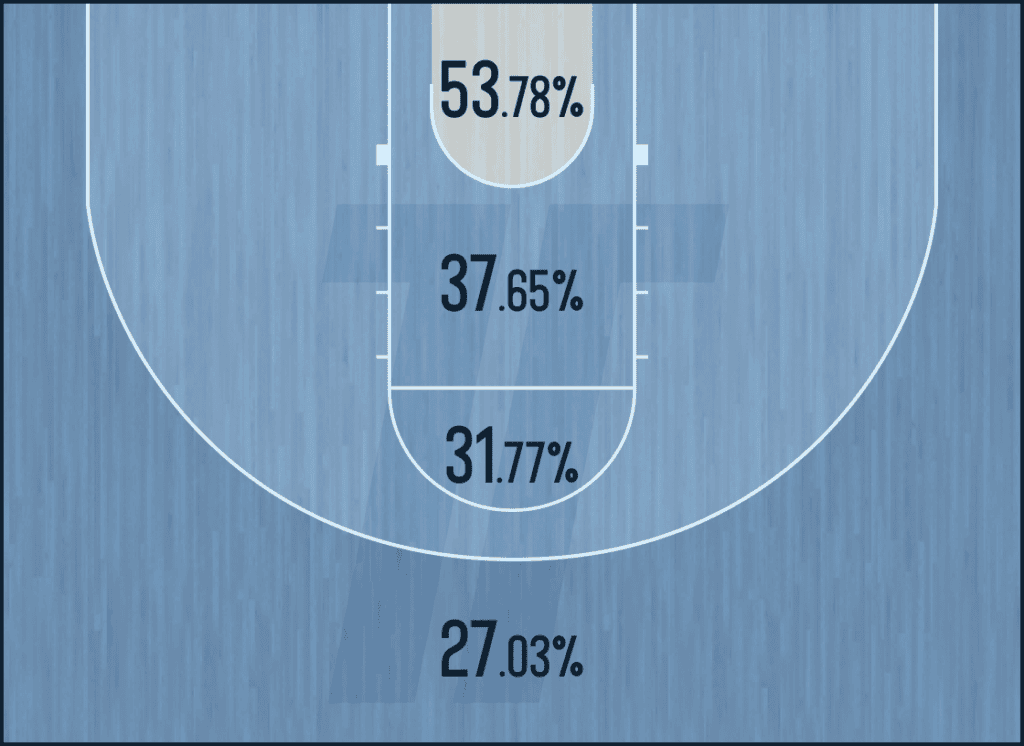
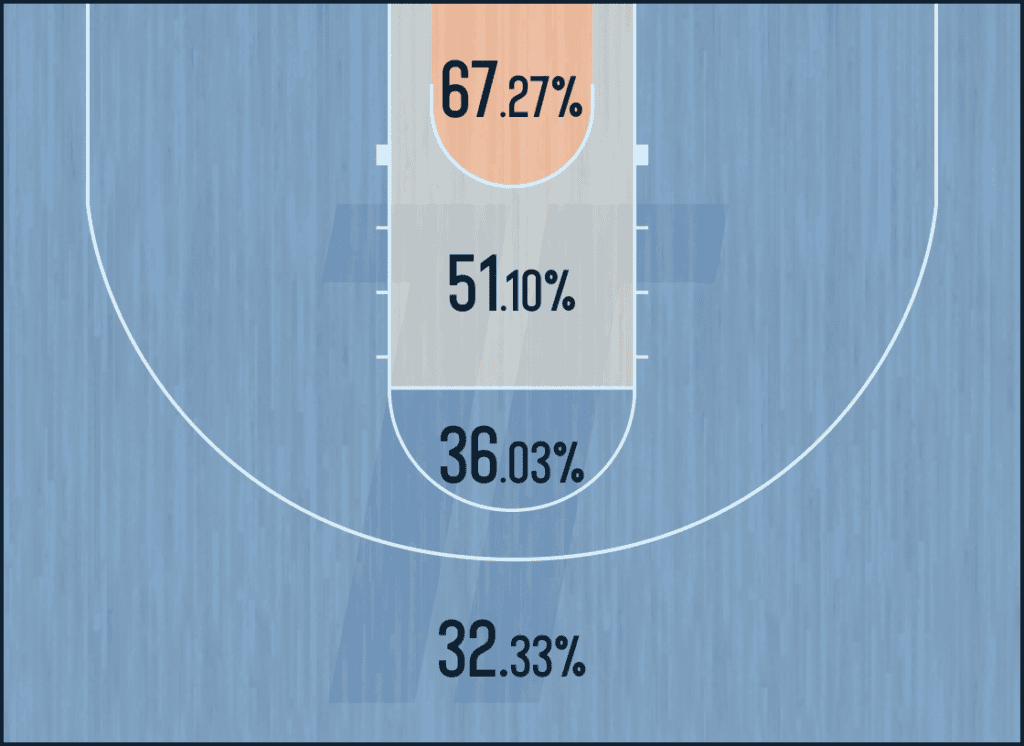
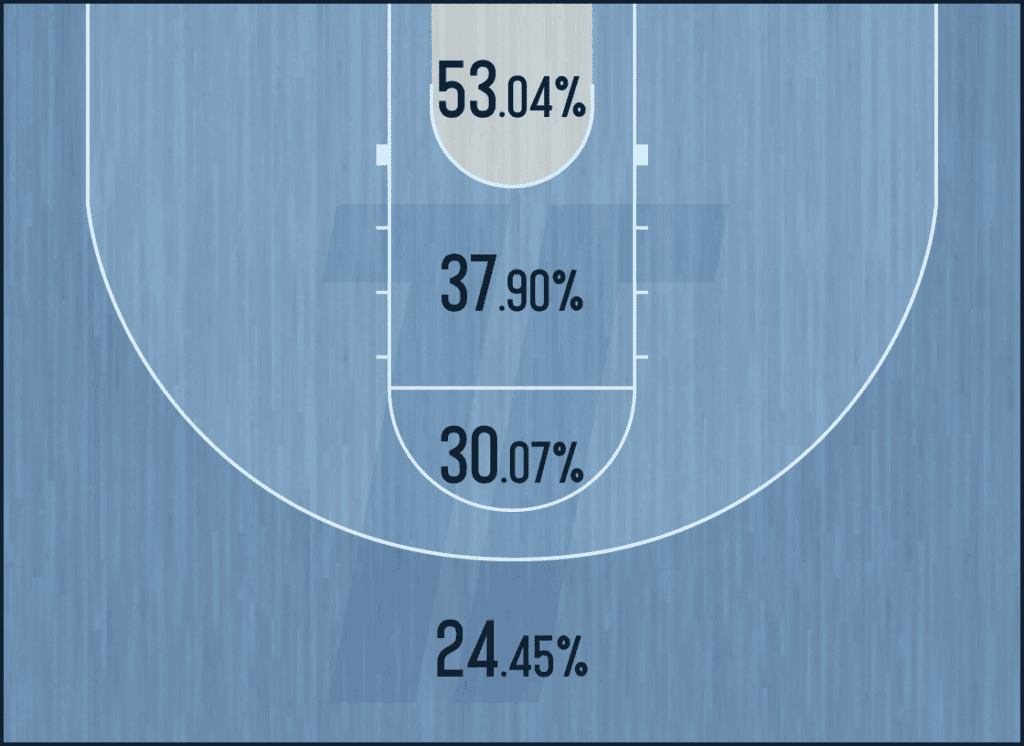
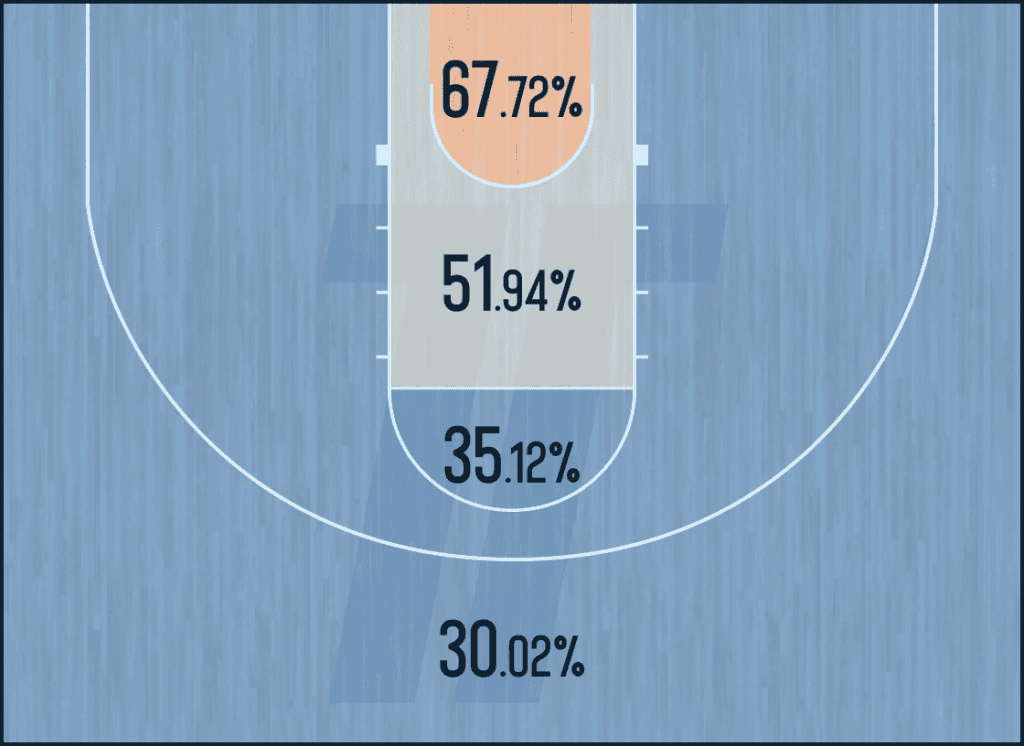
Despite both position groups showing improvement from OTD FG% to CAS FG%, there are a few interesting disparities across the positions. Bigs retain their efficiency advantage closest to the basket, while guards separate in the midrange. Bigs finish slightly better than guards at the rim in both OTD and CAS situations (about 1 – 2 percentage points), but guards consistently shoot better from midrange off the dribble – by 3.5 percentage points in the men’s game and 1.7 percentage points in the women’s game.
Three-point efficiency drops significantly on off-the-dribble attempts for everyone. Men average 31.2% from three off the dribble across all position groups, and women average 27.1%. On the women’s side, the efficiency gap between bigs and guards on off-the-dribble threes is notable, with bigs shooting 24.5% from three OTD and guards at 27.3%.
What This Tells Us
The patterns across all of this data are consistent between the men’s and women’s games, which makes the conclusions reliable. Guards shoulder most of the self-created offense, particularly in the midrange and at the three-point line. Bigs are more reliant on catch-and-shoot opportunities and benefit from them accordingly, especially near the basket where the efficiency gain from receiving versus creating is most pronounced.
For coaches, the practical implication is fairly clear. The field goal percentage differences between catch-and-shoot and off-the-dribble attempts, across every zone and both position groups, show a consistent cost to forced creation.
All data sourced from ShotTracker. Analysis covers Division I men’s and women’s basketball.