Note: “Bigs” includes Forwards and Centers. “FGA” refers to field goal attempts, “3FGA” refers to three-point attempts, and “FTA” refers to free throw attempts.
Last time, we examined our first “clutch” scenario, specifically games within five points during the final four minutes. This time, we’re looking at a different kind of pressure – possessions with five or fewer seconds remaining on the shot clock. Unlike close-game situations, these moments can occur at any point in a game, but they present the same challenge: creating a quality shot before time expires.
Late-clock shots have long been considered some of the most difficult attempts in basketball. By this point, the defense has often disrupted the offense’s primary and secondary actions, leaving the ball handler to create a shot before the buzzer and team turnover. These moments when the offensive team does make the shot often become the instant highlights or crucial turning points in a game.
Who is taking the shots at the end of the shot clock?
The shift isn’t dramatic, but it is consistent. As a possession become more difficult, offensive responsibility shifts even further toward the players most capable of creating their own shot.
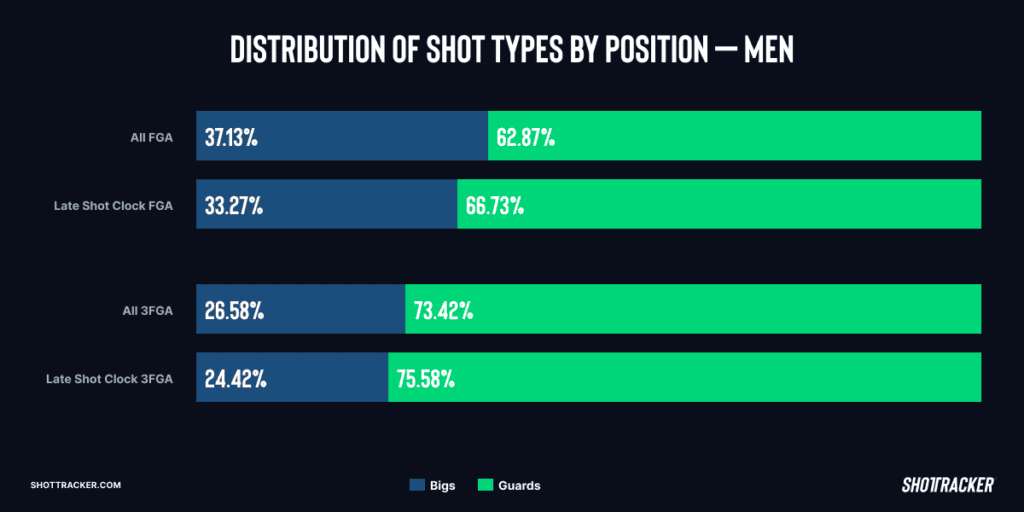
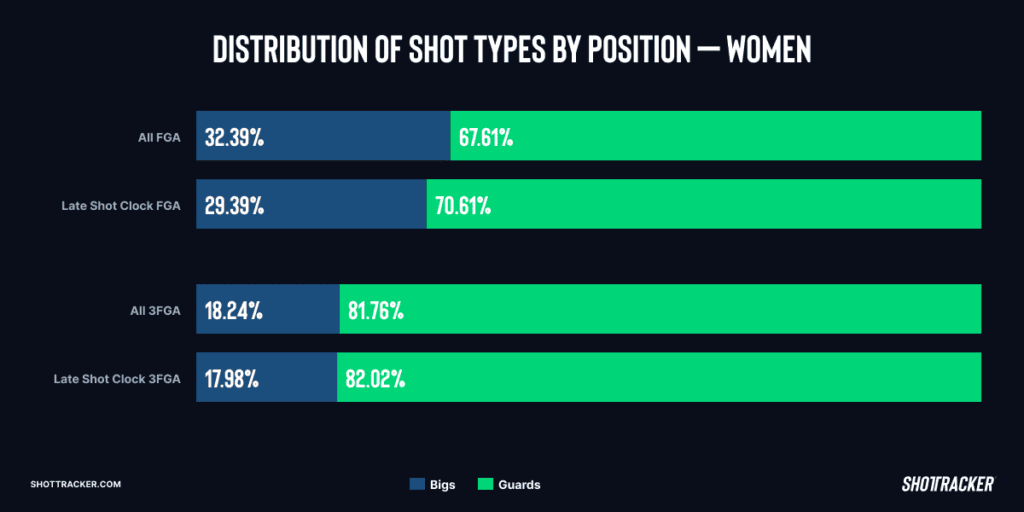
The data illustrates a greater offensive burden on guards when the shot clock is low. While guards already account for the majority of shot attempts over the course of a game, their share grows even larger during late-clock possessions, going up four percentage points for men. Women’s guards go up three percentage points in field goal attempt usage as well. These are often the players asked to create offense when a possession stalls, whether by attacking off the dribble or creating separation for a last-second perimeter attempt.
How do shots at the end of the shot clock change?
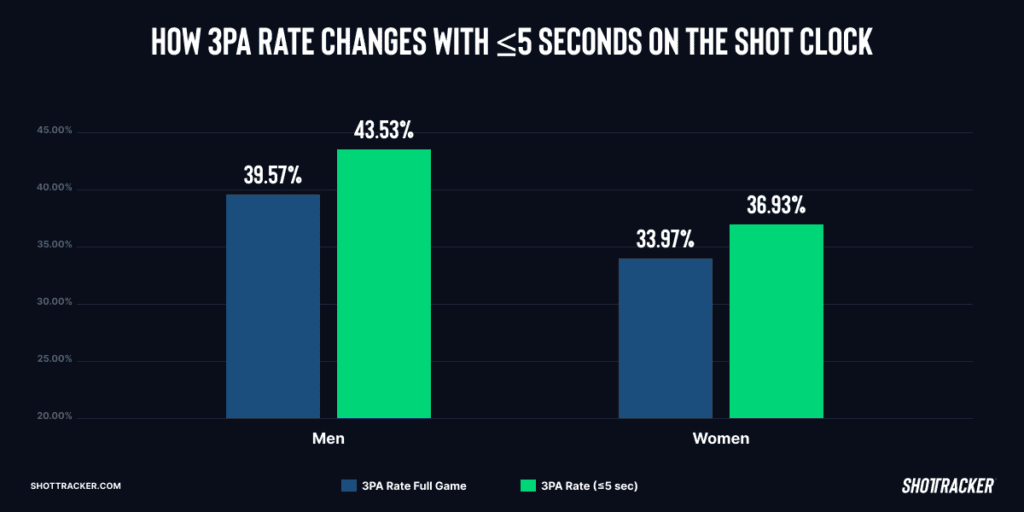
As the shot clock is expiring, offenses are significantly more likely to settle for a three. On the men’s side, the overall 3PA Rate of 39.6% jumps four percentage points to 43.5%. With five seconds of less on the shot clock, nearly every other shot is a three-pointer. It’s the same for the women–jumping from a 3PA Rate average of 34.0% to 36.9%.
This shift reflects how offenses evolve as a possession breaks down. Early in the shot clock, teams have time to run multiple actions, get the ball into the paint, and create relatively easier scoring opportunities. With only a few seconds remaining, those options largely disappear. Rather than forcing a difficult pass inside with the clock expiring, ball handlers are more likely to create a late pull-up or kick the ball out for a tightly contested three.
Naturally, these more difficult shot attempts come with a cost. As the shot clock winds down, efficiency drops sharply across every position group.
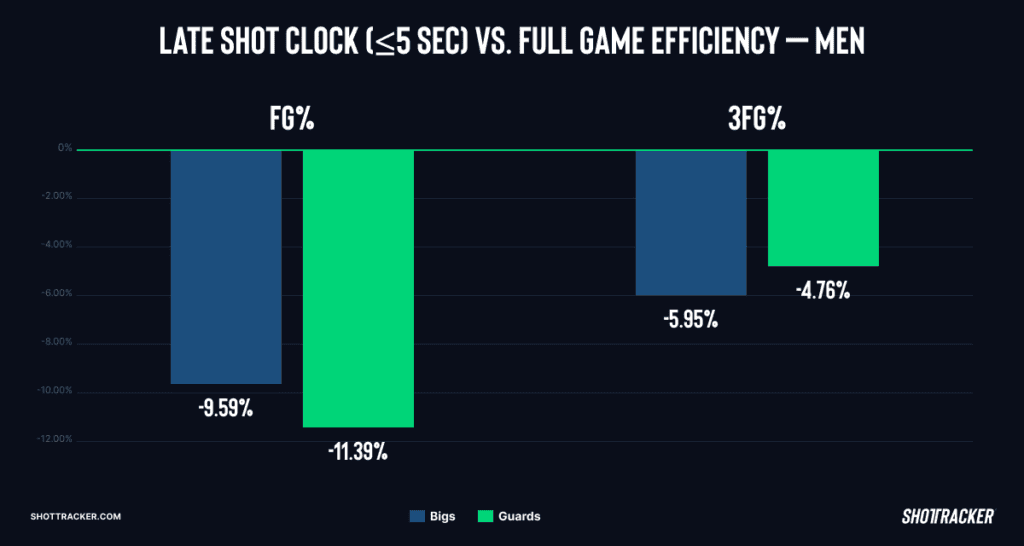
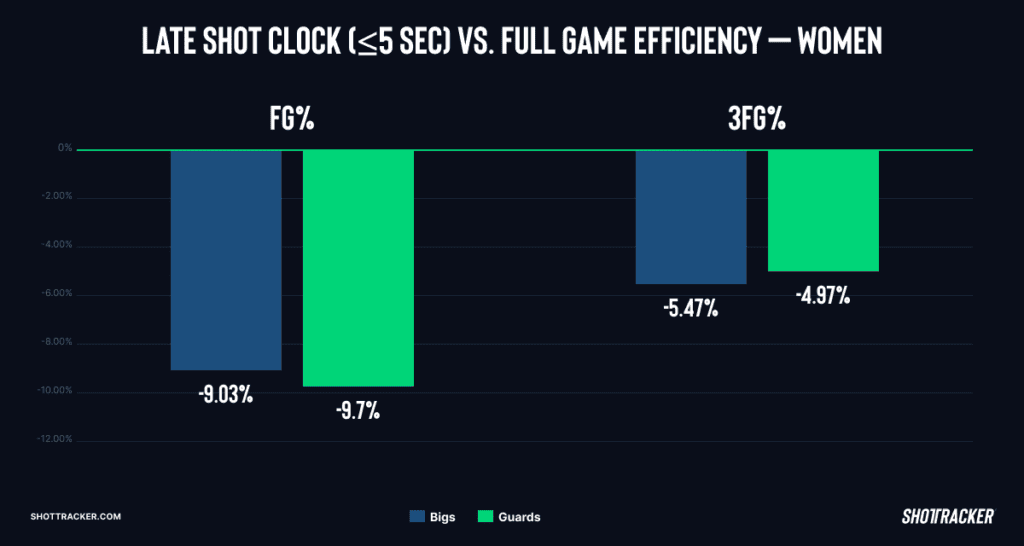
It doesn’t matter what gender either – there is also a significant drop off in efficiency in both field goal percentage (FG%) and three-point field goal percentage (3FG%) when looking at shots in the last five seconds of the shot clock versus all shots over the span of a game. For men’s bigs, we see a fall off from 49.9% for FG% on average to just 38.5% at the end of the shot clock. Guards’ three point shooting heavily decreases as well, down six percentage points from 34.4% to 28.5%.
The efficiency decline is not surprising given the circumstances. By the time the shot clock reaches five seconds, defenses have typically forced offenses out of their primary actions. Many late-clock attempts come off isolation plays, contested jump shots, or rushed shots against a set defense—which are inherently lower-percentage opportunities than shots generated earlier in the possession.
The consistency of these declines across both the men’s and women’s games reinforces that this is not simply a product of player talent or offensive philosophy. Rather, it reflects the universal challenge of scoring when time is the primary constraint. Whether it’s an All-American guard or a role-playing big, late-clock possessions are among the most difficult shots a player will take all game.
Ultimately, these findings paint a clear picture of how offenses evolve as the shot clock expires. Teams place greater responsibility on guards, become more reliant on three-point attempts, and ultimately accept lower shooting percentages in exchange for simply getting a shot before time runs out.
All data sourced from ShotTracker. Analysis covers Division I men’s and women’s basketball from the 2025-26 season. Want to see how your program’s late shot clock data compares to Division I averages? Request a demo at shottracker.com/request-a-demo.