Part 1 of this series covered pace of play. Despite the jump in athleticism at the college level, the game actually slows down. Fewer transition possessions. More shot clock usage in the half court. A more patient approach to offense overall.
Part 2 shifts focus to shot selection: where players are shooting from, the types of shots they are taking, and how those shots are being created. ShotTracker tracks detailed data on every field goal attempt, which makes it possible to compare offensive decision-making across levels. Here is what the numbers show about how shot selection changes from elite high school basketball to the NCAA.
The Men’s Game: A Shift in How Shots Are Created
The modern college basketball conversation revolves around the three-point shot. But the shift from high school to college is more modest than the reputation suggests. Elite high school boys attempted three-pointers on 37.8% of their field goal attempts. At the NCAA men’s level, that number rises to 39.6%. The increase is real, but it is relatively small. The more notable shift is in how shots are being created.
Catch-and-shoot opportunities made up 46.3% of shots at the elite high school level and increased to 48.1% in the NCAA. Off-the-dribble attempts moved in the opposite direction, from 53.7% in high school to 51.9% at the college level. College offenses generally feature better spacing, more screening actions, and more movement before the ball is caught. As a result, more shots are taken off the catch rather than off the dribble. Whether that shift produces better shots is a separate question. What the data shows is that the type of shot being taken changes.
Better defenses should produce more guarded shots. The data shows the opposite trend. It is worth asking why.
Guarded attempts fell from 82.4% in elite high school play to 79.7% in the NCAA. Unguarded shots increased from 17.6% to 20.3%. One reasonable explanation is that college offenses run more structured actions, use more movement, and generate more open looks through execution rather than through individual creation. But without ShotIQ data validating the quality of those looks, we can say with confidence that the distribution shifts, not that the shots themselves are better.
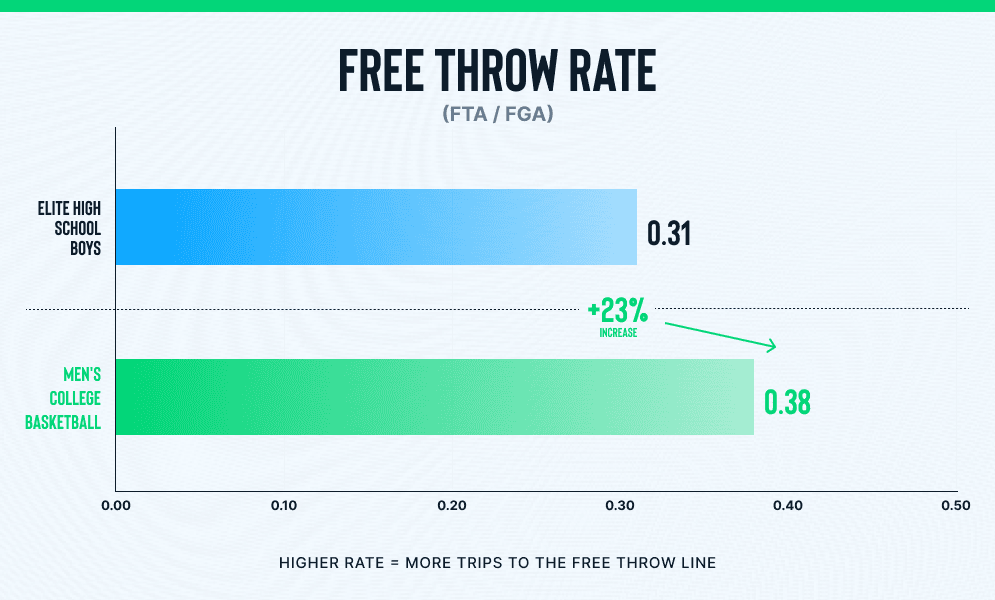
The free throw rate tells a cleaner story because the outcome is directly measurable. NCAA men’s teams posted a free throw rate of 0.38, compared to 0.31 for elite high school boys, a 23% increase. Getting to the line is one of the most efficient ways to score in basketball, and college offenses earn that opportunity at a meaningfully higher rate.
The Women’s Game: A Different Shot Profile
The women’s game tells a different story at the shot selection level, and it cuts against what most people would expect.
Elite high school girls attempted three-pointers on 39.0% of their shots. At the NCAA women’s level, that number drops to 34.0%. Rather than increasing three-point volume, college women’s offenses shift toward the midrange. Attempts from that zone increased from 10.6% in elite high school girls competition to 14.9% in the NCAA.
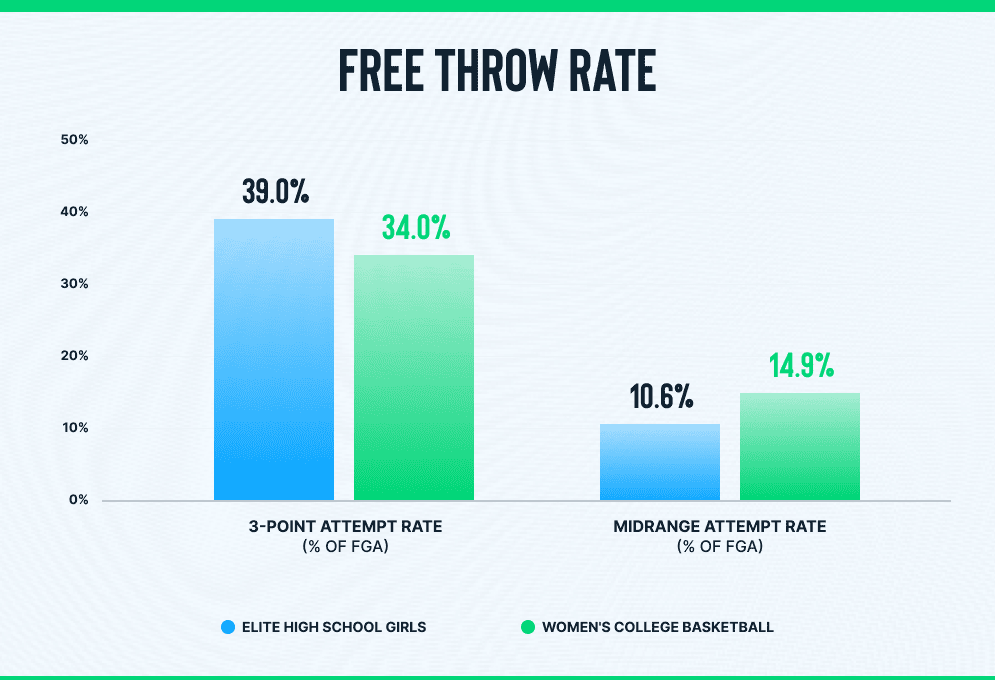
This shift reflects a real characteristic of the women’s college game. Many successful NCAA women’s offenses rely on guards and wings who are effective in the pull-up game, and defensive coverages at this level often give up midrange opportunities while protecting the basket and limiting three-point looks. The data shows that college women’s offenses take advantage of that. Whether the midrange shots they are taking are higher quality than the threes they are giving up is something ShotIQ data could answer. For now, the numbers show a clear directional shift.
On the guarded versus unguarded side, the women’s game follows the same pattern as the men’s. Guarded shots fell from 82.7% to 79.1%, and unguarded looks increased from 17.3% to 20.9%. The same explanation applies: college offenses run more structured systems with more movement, which tends to produce more open looks. The data shows the distribution changes. It does not tell us whether those unguarded looks are being taken in better spots or at better efficiency.
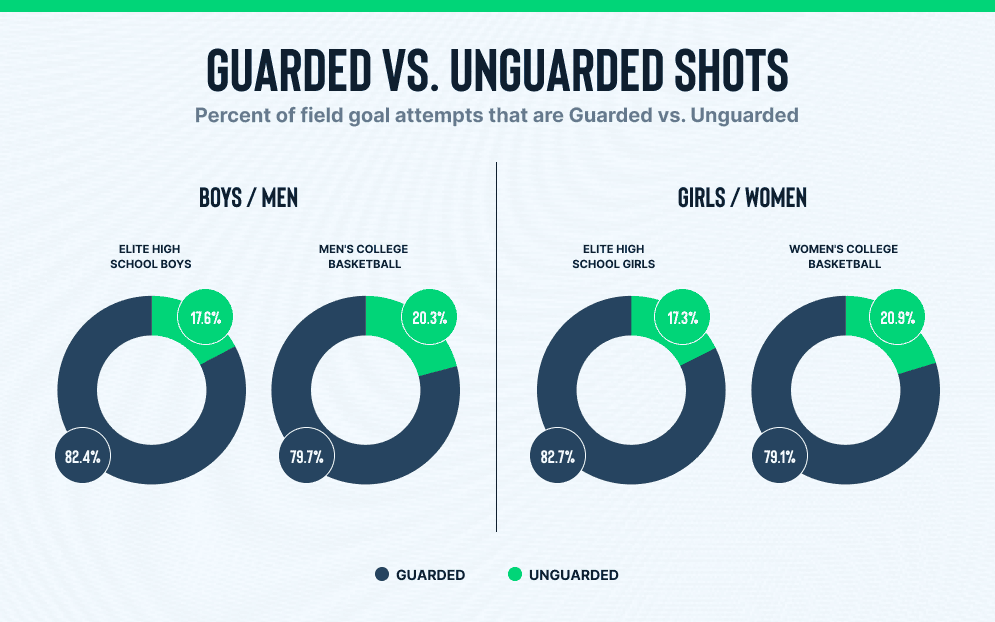
The men’s game and the women’s game follow similar patterns in some areas and diverge meaningfully in others. Both see a shift toward more unguarded attempts at the college level. The shot type distribution, however, moves in opposite directions. Men take slightly more threes. Women take notably fewer.
What the Data Actually Tells Us
The clearest takeaway from Part 2 is that shot selection changes in measurable ways from the elite high school level to the NCAA. The distribution of shot types shifts. The proportion of guarded versus unguarded attempts shifts. The free throw rate shifts. These are real, documentable differences.
What the data does not tell us on its own is whether those shifts reflect better decision-making or simply different decision-making. For that, we would need ShotIQ validation to evaluate the quality of the shots being taken, not just the type. That is a separate and important layer of analysis, and it is worth exploring in a future piece.
What we can say is that the college game looks different at the shot selection level, and understanding those differences is useful for any player preparing to make the jump. The athletes around you change. So does the way the game is played.
Next in the series: How Ball Movement Changes from Elite High School Basketball to the NCAA.
Sources
High school boys data from the 2024-25 EYBL Scholastic League.
High school girls data from the 2025 EYBL Summer League.
NCAA data sourced from ShotTracker partner programs.