Player Archetypes • Part 2 of 4
Shot Profile told you how a player attacks. Offensive Impact tells you what they actually produce.
The Shot Profile archetypes from Part 1 of this series mapped where players operate offensively and what their tendencies look like, without regard to how productive or efficient those tendencies are. This installment goes further. The Offensive Impact model pulls in Points/Game, Offensive Rebounds per 100 Possessions, Free Throw Rate, shooting efficiency, and more, building a picture not just of a player’s style, but of the role they fill and how much they deliver in it.
As with Shot Profile, men’s and women’s players were modeled independently. The same offensive role can look different across the two games, and the data reflects that. This time, both datasets produced the same number of groupings: six Offensive Impact archetypes for men’s basketball and six for women’s.
Men’s Offensive Impact Archetypes (Showing 3 of 6)
Each graph shows where the average player within an archetype ranks percentile-wise across each statistical category.
Interior Producer
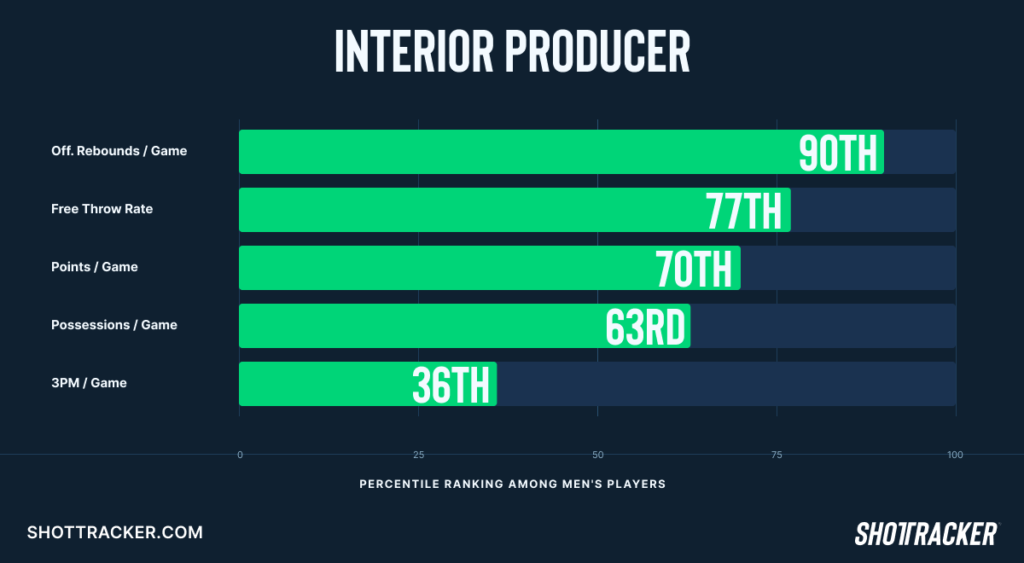
Some players don’t need the ball in their hands to make an offense run. The Interior Producer is built around activity near the basket, second chances, and getting to the line, and the numbers make that identity impossible to miss.
Interior Producers rank in the 90th percentile in Offensive Rebounds/Game. That’s not a role player stat. That’s a possession-extending weapon. Add a 77th percentile Free Throw Rate alongside a 70th percentile scoring output, and you’re looking at a player whose impact is tied directly to what happens after a shot goes up, not just when it goes in. Three-point production is minimal at the 36th percentile. That’s not a flaw. It’s a feature. These players don’t need range. They need space, effort, and the relentlessness to go get a ball that no one else did.
Notable Interior Producers, 2025-26 NCAA Season: Cameron Boozer (Duke), JT Toppin (Texas Tech), Graham Ike (Gonzaga)
Perimeter Scorer
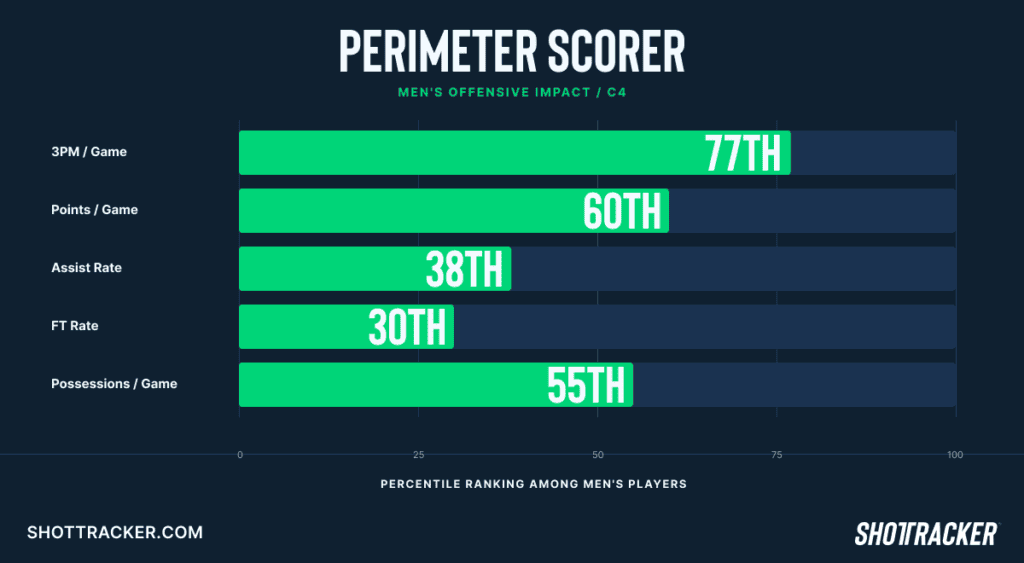
The Perimeter Scorer speaks one primary language: the three. At the 77th percentile in made threes per game, perimeter production is the engine that drives everything else. The overall scoring that follows, 60th percentile in Points/Game, reflects what happens when a team keeps the ball moving to the right spot for the right player.
What the numbers also tell you is what this archetype isn’t. A 30th percentile Free Throw Rate means these players aren’t drawing contact or attacking the rim as a focal point. A 38th percentile Assist Rate confirms they’re filling a scoring role, not a facilitating one. That’s not a limitation. It’s clarity. A coaching staff that knows it has a Perimeter Scorer understands exactly how to deploy one.
Notable Perimeter Scorers, 2025-26 NCAA Season: Juke Harris (Wake Forest), Richie Saunders (BYU), John Blackwell (Wisconsin)
Secondary Playmaker
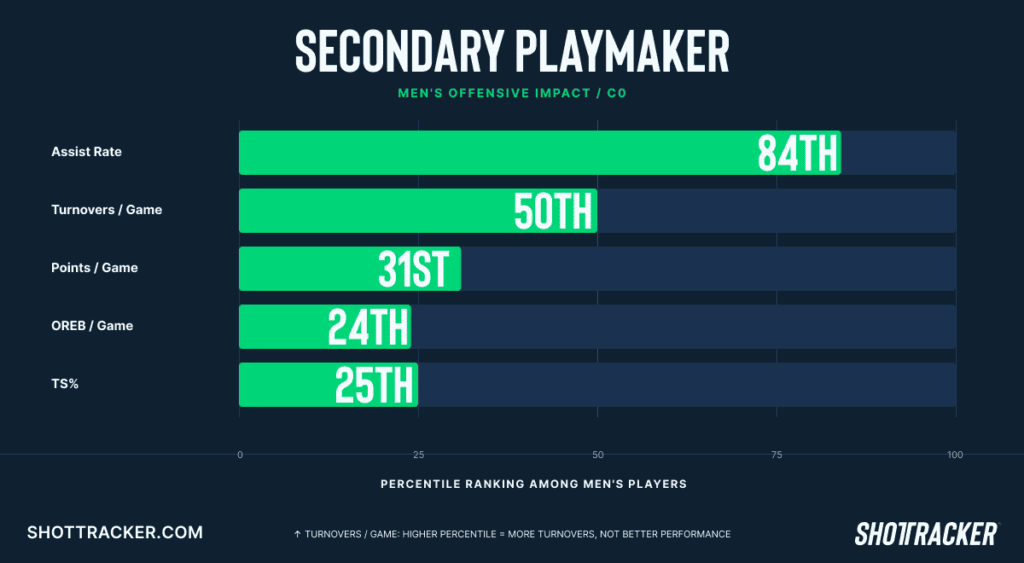
Not every offense needs another scorer. Sometimes what it needs is someone who can move the ball, limit mistakes, and put teammates in position to produce. That’s the Secondary Playmaker.
An 84th percentile Assist Rate tells most of the story. An 85th percentile Assist-to-Turnover Ratio tells the rest: these players are making plays, and they’re not giving them back. Individual scoring production sits at the 31st percentile in Points/Game and the 25th percentile in True Shooting Percentage, but that context matters. The Secondary Playmaker isn’t asked to carry an offense. They’re asked to run it. There’s a reason every winning team has one.
Notable Secondary Playmakers, 2025-26 NCAA Season: Sam Hoiberg (Nebraska), Drake Allen (Utah State), JJ Starling (Syracuse)
Women’s Offensive Impact Archetypes (Showing 3 of 6)
Note: Each graph shows where the average player within an archetype ranks percentile-wise across each statistical category.
Offensive Engine
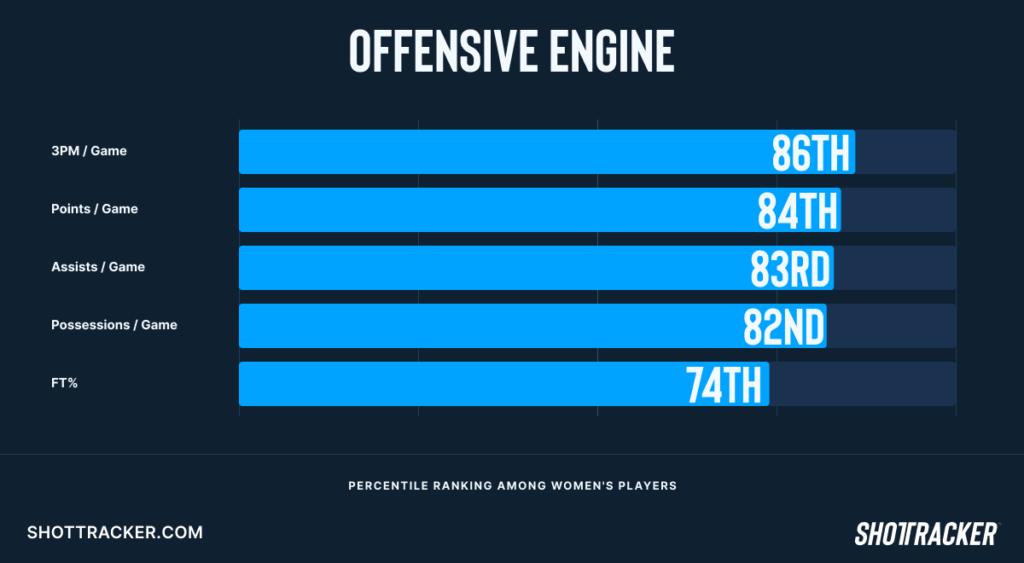
Some archetypes are defined by a single strength. The Offensive Engine is defined by all of them.
At the 84th percentile in Points/Game, 83rd in Assists/Game, and 86th in made threes per game, the Offensive Engine doesn’t just contribute. She dictates. An 82nd percentile Possessions/Game makes clear that this archetype isn’t producing efficiently within a small role. She’s carrying an offense, game in and game out, doing damage across every statistical category the model tracked. Finding a player who fits this archetype doesn’t just change how you game plan. It changes how you build a roster.
Notable Offensive Engines, 2025-26 NCAA Season: Jaloni Cambridge (Ohio State), Halli Poock (Murray State), Maggie Doogan (Richmond)
Primary Playmaker
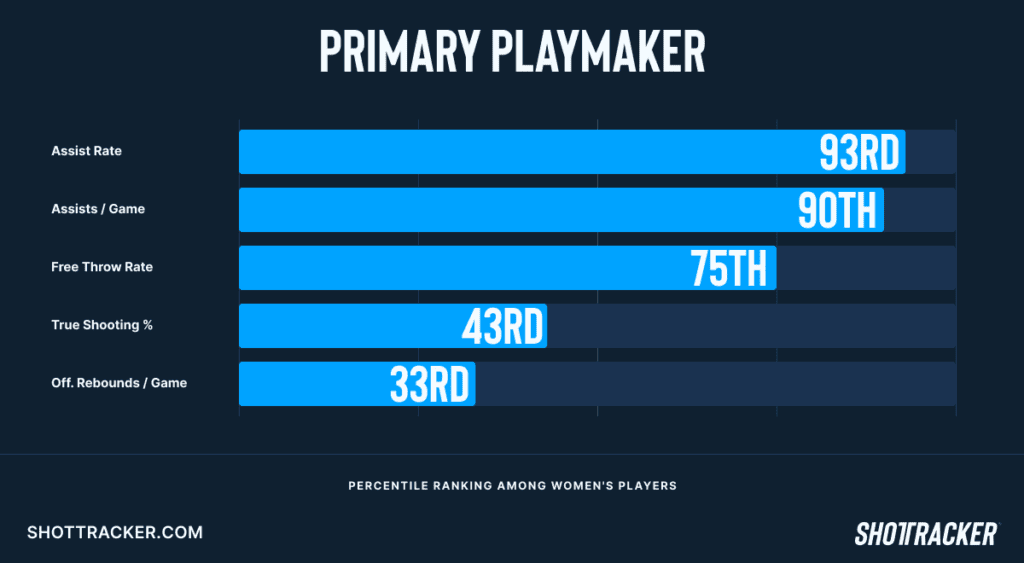
The Primary Playmaker has a singular focus: make everyone else better.
A 93rd percentile Assist Rate is among the highest marks across any women’s Offensive Impact archetype. These players see the floor differently, and they translate that vision into scoring opportunities at an elite level. Individual scoring output lands near the middle of the pack at the 49th percentile in Points/Game, but that’s the point. The Primary Playmaker’s value doesn’t live in her own box score line. It lives in everyone else’s.
A 75th percentile Free Throw Rate adds another dimension, showing that even in a pass-first role, the Primary Playmaker can still create advantages and extend possessions when the moment demands it.
Notable Primary Playmakers, 2025-26 NCAA Season: Jada Williams (Iowa State), Ta’Niya Latson (South Carolina), Jordan Harrison (West Virginia)
Low-Usage Contributor
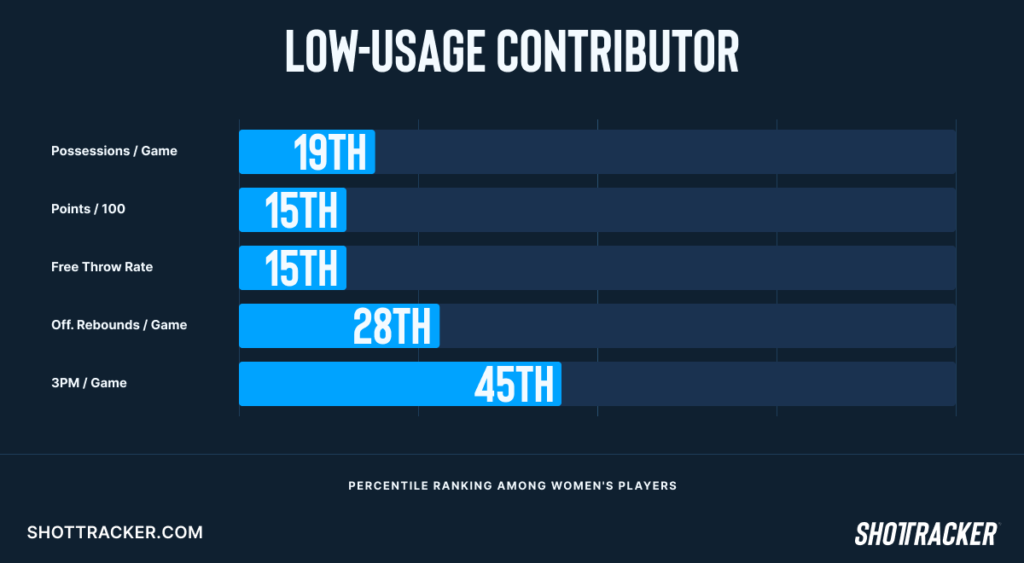
Not every player on a roster carries a heavy offensive workload, and the data reflects that reality with its own archetype.
A 19th percentile Possessions/Game defines the role before anything else does. Scoring output follows at a limited rate, but a 45th percentile mark in made threes per game tells a more interesting story: within a constrained role, these players still stretch the floor and contribute from the perimeter. The Low-Usage Contributor isn’t the focal point of an offense. She’s the piece that rounds a roster out, and teams that understand her value use her accordingly.
Up Next: Part 3 – Defensive Impact
Offensive Impact archetypes clarify a player’s offensive role, whether they’re putting up points, setting up teammates, or doing the unglamorous work on the glass to give their team extra possessions. But offense is only half the game.
Part 3 of the Player Archetypes series shifts to the defensive end: rebounding, rim protection, defensive playmaking, and the statistical signatures that separate elite defenders from everyone else.