NIL, the NCAA Tournament, and what the data tells us about the price of March.
College basketball has always rewarded the teams that build the best rosters. But in the NIL era, “building a roster” has a price tag attached, one that’s increasingly visible, even if the exact figures remain murky. For the first time, we have enough data to start asking a question that athletic directors, conference commissioners, and coaches think about every single day: What is the NIL cost of building an NCAA tournament team that can compete in and win?
This is the first in a series where we break down the financial structure of March Madness from the ground up. We start with what the data shows about the cost of building a 1-seed, what a Final Four run actually requires in NIL investment, and how that compares to what conferences get back in direct tournament revenue.
The Unit System: How Tournaments Turn Into Dollars
Before we get to cost, it helps to understand the revenue side. The two are directly connected.
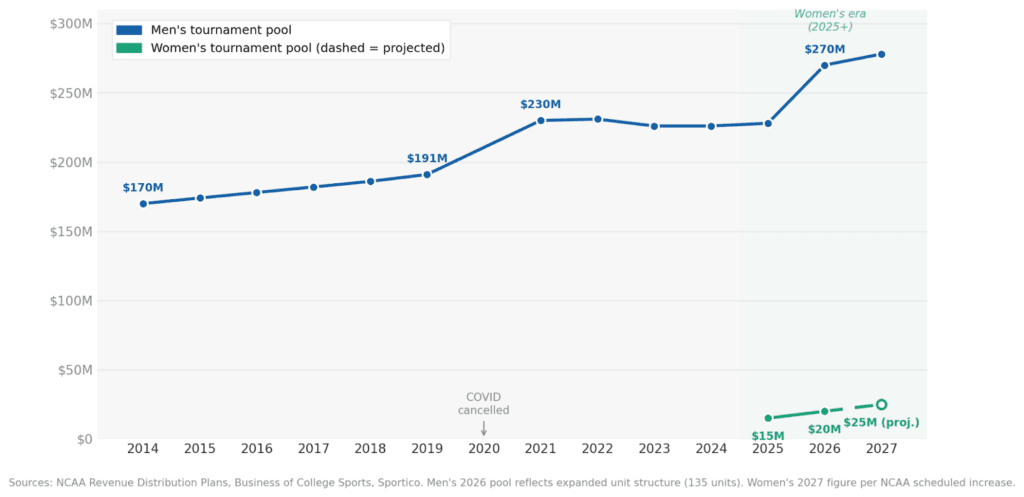
When a team plays in the NCAA Tournament, its conference earns what the NCAA calls a “unit.” Each unit in the men’s tournament is worth approximately $2 million, paid out to the conference over six years. Win a game, earn a unit. Make the Final Four, earn five units total. In 2026, the NCAA expanded the unit structure to include the national championship game and the title itself, bringing the total units available to 135, worth more than $270 million in aggregate.
The women’s tournament runs on the same logic, but at a different scale. Each unit is worth approximately $150,000, paid out over three years, drawing from a $20 million pool in 2026. That’s up from $15 million in 2025, the first year the women’s system existed at all. The pool is projected to grow to $25 million in 2027.
Critically, that money doesn’t go to the team that earned it. It goes to the conference, which then distributes it to its members, typically evenly, regardless of who actually played.
What It Costs to Be a 1-Seed
Using reputable NIL estimates, we looked at the roster investment for every team in the 2026 NCAA Tournament. The range is stark.
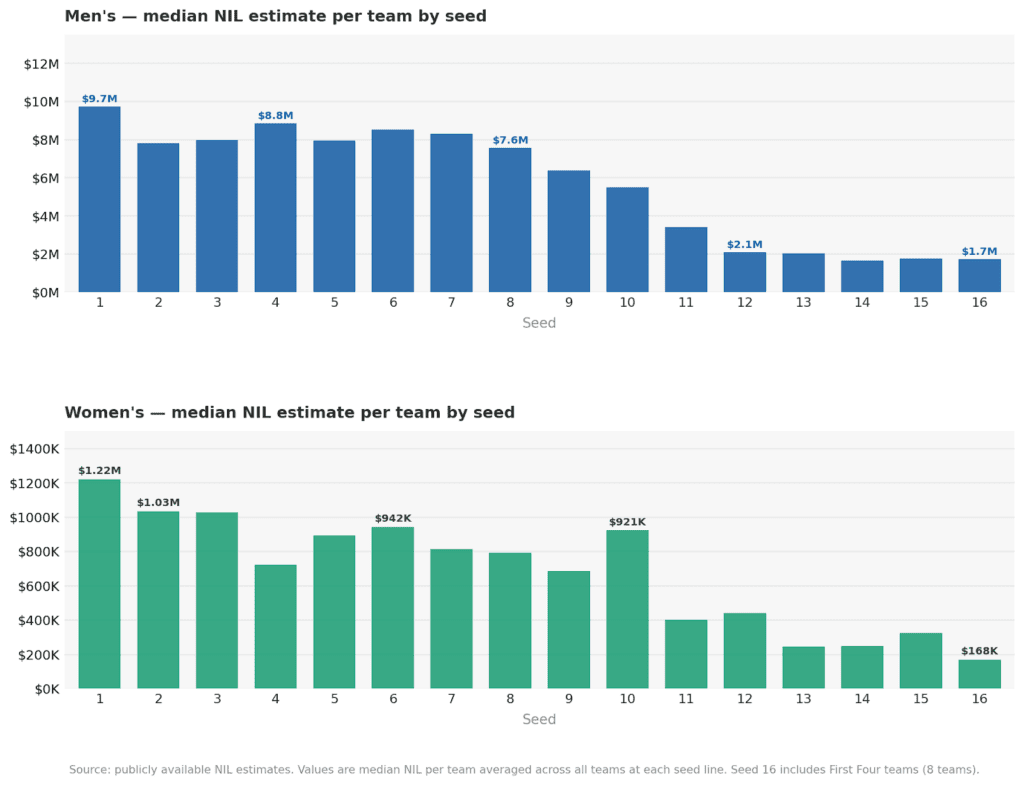
On the men’s side, a 1-seed costs an estimated $8.35M to $11.63M in NIL investment. On the women’s side, the picture looks entirely different; a 1-seed costs an estimated $1.07M to $1.41M. That’s roughly a 10-to-1 spending gap, and it reflects both the relative maturity of each NIL market and the revenue each program generates. The women’s basketball landscape is growing fast, but it hasn’t yet reached parity with the men’s financial ecosystem.
What the data also shows is that seeding and spending don’t always move together. On the women’s side, the Big 12 carries above-average roster investment across multiple seed lines, reflecting the conference’s commitment to the sport well beyond just its top programs.
The men’s side tells a similar story, but with a different wrinkle. Several traditional blue blood programs appear at seeds 4 through 8 with budgets that rival or approach 1-seed spending levels.
Where the selection committee places a team on bracket day doesn’t always reflect where a program sits in the NIL market. Conference affiliation and program history often drive investment.
The Final Four Paradox
Men’s Final Four teams in 2026 carried estimated NIL rosters of $6.81M to $11.54M, a range that overlaps with, and in some cases falls below, what several first and second round exits spent on their rosters. On the women’s side, Final Four teams carried estimated rosters of $1.07M to $1.72M, a similar pattern where deep tournament runs were not exclusively the product of the highest spenders in the field.
The relationship between NIL investment and tournament advancement isn’t linear on either side. Spending more buys a more competitive roster on paper. Whether that translates into wins depends on coaching, health, matchups, and the unpredictability that defines March basketball.
The Bottom Line
The NIL era has changed nearly everything about how college basketball rosters get built. The transfer portal moves faster. The price of a starting five is now a line item. Coaches recruit with checkbooks alongside championship banners.
But the data makes one thing clear: spending more doesn’t automatically mean winning more. A higher NIL investment buys a more competitive roster on paper. It doesn’t buy the coaching adjustments, the chemistry, the health, or the matchup luck that tournament runs are built on. Some of the deepest runs in 2026 came from programs that spent well below the top of the market.
NIL is important. It has raised the floor for what it takes to compete and widened the gap between programs that can participate in the market and those that can’t. But it is one input into a much more complicated equation, and the sport hasn’t yet settled on what the right formula looks like.
In the coming years, we may find out the exact recipe to make the tournament, make a run, and make history.
Next in this series: we break down the direct ROI on NIL spending for every conference in the 2026 men’s and women’s tournaments, and ask which programs are getting the most out of every dollar they spend.